Gluten-free in Greece: what the label and the taverna promise, and what to ask
Short answer
Greece follows the EU rule: “gluten-free” on a pack or a menu means no more than 20 mg of gluten per kg of food as sold1, 9. The claim is only half the picture, because the Hellenic Coeliac Society lists gyro, meatballs with breadcrumbs, béchamel and floured fried foods among the places wheat hides in Greek cooking2, 3, 4, 5. At a taverna, ask about three things:
- The fryer. The Society lists floured fried cod, calamari and zucchini, and anything fried in the same oil5.
- The grill and the bread. Cross-contact generally happens through shared utensils or a shared cooking or storage environment6, and pita is on a charity’s list of foods that contain gluten7, so ask what else is cooked or warmed where your food goes.
- The dish itself. Gyro, meatballs, béchamel and sauces bound with flour all appear on the Society’s list2, 3, 4.
- Gluten-free limit
- No more than 20 mg of gluten per kg of food as sold to the final consumer1; the regulation is directly applicable in all member states8
- Set by
- Commission Implementing Regulation (EU) No 828/20141
- Oats
- In a food presented as gluten-free, oats must be specially produced to avoid contamination by wheat, rye, barley or their crossbred varieties, and their gluten content cannot exceed 20 mg/kg27
- Celiac society
- Hellenic Coeliac Society (Ελληνική Εταιρεία Κοιλιοκάκης)
Part of Travel: Europe, 19 guides
Key points
- Greek “gluten-free” is the EU claim: no more than 20 mg/kg, in a regulation that applies directly in every member state1, 8.
- The Hellenic Coeliac Society says the rule covers non-packaged food, for example in restaurants, bakeries and pastry shops, as well as packs, and that contamination in the kitchen counts9, 10.
- Greek law on non-packaged food reaches the possible, unintended presence of allergens, and oral answers are allowed only under three conditions11, 12.
- Orzo (kritharaki) is wheat pasta13, 46, phyllo in one maker’s spinach pie lists wheat flour14, and pita is on the Celiac Disease Foundation’s list of foods that contain gluten7.
- “Very low gluten”, up to 100 mg/kg, is a different claim from “gluten-free”15.
What «χωρίς γλουτένη» commits a maker or kitchen to
A Greek pack or menu uses the EU wording. The statement “gluten-free” may only be made where the food as sold to the final consumer contains no more than 20 mg/kg of gluten1; the Hellenic Coeliac Society writes it in Greek as «χωρίς γλουτένη»16.
The regulation is binding and directly applicable in all member states8, and it covers information on gluten in food without limiting itself to packs17. The Hellenic Coeliac Society, which AOECS lists (as “Hellenic Coeliac Association”) as Greece’s member18, says it applies to packaged and non-packaged food alike, for example in restaurants, bakeries and pastry shops9.
For comparison, FDA adopted less than 20 ppm gluten as one criterion for a US “gluten-free” label19. That is FDA’s rule for US labels; on a Greek pack the EU regulation is the one that applies8.
| Greek | What the regulation says it means |
|---|---|
| «χωρίς γλουτένη» | “gluten-free”: no more than 20 mg/kg of gluten in the food as sold1, 16 |
| «πολύ χαμηλή περιεκτικότητα σε γλουτένη» | “very low gluten”: a different claim, allowed only for food with wheat, rye, barley or oat ingredients specially processed to reduce gluten, up to 100 mg/kg15; the Society’s Greek wording for it20 |
| «κατάλληλο για άτομα με κοιλιοκάκη» | “suitable for coeliacs”: a statement that may accompany the gluten-free claim21, 22 |
| σιτάρι · σίκαλη · κριθάρι · βρώμη | wheat · rye · barley · oats: the order the gluten regulation uses in English15, and the order Annex II of the food-information regulation uses in Greek24 |
| όλυρα | spelt, which the gluten regulation lists with durum and khorasan wheat as kinds of wheat23; Annex II of the food-information regulation, in its Greek text as adopted, names όλυρα where the English text names spelt24, 32 |
| «περιέχει» | “contains”: the word the allergen rule uses when a food has no ingredient list25, 26 |
Oats in a food presented as gluten-free must have been specially produced, prepared or processed to avoid contamination by wheat, rye, barley or their crossbred varieties, and the oats cannot exceed 20 mg/kg27.
Greece also has a certified mark. The Society describes the Crossed Grain trademark as a gluten-free mark controlled by Europe’s coeliac societies28, and in Greece the licence to use it is the Hellenic Coeliac Society’s to give29. The Society says other “gluten free” icons on packs are not that certified mark: the maker commits to the 20 mg/kg limit, but there is no additional independent check30.
Reading a Greek ingredient list
Under the EU allergen rule, the name of a gluten cereal in the ingredient list has to be emphasised, for example by font, style or background colour31, 32. The cereals are the ones in Annex II, which as adopted in 2011 reads: wheat, rye, barley, oats, spelt, kamut or their hybridised strains, and products thereof, with exceptions32. Where a food has no ingredient list, the allergen follows the word “contains”25, in Greek «περιέχει»26.
Language is a national choice: a member state may require the particulars in one or more of the Union’s official languages within its own territory33. For non-packaged food in Greece the national decision says the information must be given in Greek, with other languages allowed as well34.
The Society’s label page flags a bare «αλεύρι» in a Greek ingredient list, with no grain named. It reports that in May 2026 EFET, the Hellenic Food Authority, recalled traditional rusks because the Greek ingredient list gave only that word and did not say the flour was wheat35. When a Greek list names no grain, the cereal names in the table above are what to look for, and a bare word is a question for the maker.
Wording such as “may contain traces of wheat” is precautionary labelling. On packaged food the Society says it is optional36, that there is not yet a single European limit, wording or testing duty, and that each company decides for itself37. It adds that a pack with neither a “may contain” line nor a gluten-free claim has not for that reason been checked for contamination38.
What a taverna has to tell you
EU law makes allergen information, gluten cereals included, mandatory for food offered to consumers or mass caterers without prepackaging32, 39. Greece’s national decision goes on to cover the possible, unintended presence of those substances in non-packaged food11, and the Society summarises it as every Greek eating place having to inform you about allergens and possible contamination40.
The decision says the information must be legible and given before the sale34. It may not be given orally unless three conditions are met together12: a visible sign, a written or electronic copy on the premises, and trained staff or an electronic means to give it41.
For a dish that a menu calls gluten-free, the Society says the 20 mg/kg limit applies and that it is not enough for no gluten to be visible, because contamination in the kitchen counts10.
If a server answers by mouth, look for the sign and ask whether the written or electronic list is on the premises: the decision requires one before staff may answer orally12, 41.
Gyro and souvlaki
The Society’s list of hiding places names gyro, together with cold cuts, stock cubes and spice mixes, which it says often contain flour or breadcrumbs2.
Our gyro verdict covers US-sold gyro meat and shows what each maker’s own page lists. It says nothing about a particular Greek shop’s cone, so the shop’s own answer about its cone is the evidence that counts. The bread around it is a separate wheat question, covered below.
A plain skewer fits what CYE lists as naturally gluten-free in Greek cuisine: unmarinated meat or fish42. Two things can change that. One is a spice mix, which the Society says may contain flour or breadcrumbs2. The other is the surface, since cross-contact generally happens through shared utensils or a shared cooking or storage environment6. If pita is warmed on the grill that cooks your skewer, that is a shared cooking environment in that sense.
Pita, pies and phyllo
Pita is on the Celiac Disease Foundation’s list of common foods that contain gluten7. Our pita and bread verdicts show what the packs we read list.
The Society’s list of where gluten hides in Greek cooking is introduced with the words “beyond bread, pasta and pies”43; the dishes on it are covered in the sections below.
In the one phyllo product we read, the US maker Fillo Factory describes its Classic Greek Spinach Pie as layered with crisp phyllo, spinach, leeks, herbs and feta44, and the phyllo dough in its ingredient list is made from enriched wheat flour with malted barley flour14. A taverna’s pie is the kitchen’s own, so ask what the pastry is made from rather than assuming from the filling.
Orzo, béchamel, meatballs and other cooked dishes
Orzo, called kritharaki in Greek, is wheat pasta13, 46. The Misko orzo listed by Parthenon Foods has the ingredients durum wheat semolina and water13, and the store describes it as the main ingredient of “yiouvetzi”, the traditional Greek baked pasta dish that calls for a light tomato sauce and pieces of beef or lamb45.
The Society’s list names these wheat staples: trahanas, hylopites, kritharaki, bulgur and couscous, all made from wheat46. Our couscous and bulgur verdicts show what the packs we read list, and our pasta verdict covers wheat pasta in general.
The Society lists breadcrumbs or bread crumb in meatballs, burgers, stuffed vegetables and vine-leaf rolls3, and béchamel, as in pastitsio and moussaka, and sauces bound with flour are on the same list4. Our meatballs verdict shows how makers’ recipes differ.
What usually carries no wheat, and the catch
CYE’s page for Greece points visitors to fresh grilled vegetables, unmarinated meat or fish, and potatoes cooked without flour or breadcrumbs42. The Society lists fresh fruit and vegetables47, legumes48 and milk, natural yoghurt and many cheeses49 as naturally gluten-free, and asks you to check the label on processed versions49.
Our feta, yogurt, olives and hummus verdicts show what the products we checked list.
The catch is what is added: the Celiac Disease Foundation lists salad dressings and marinades among foods that may contain malt vinegar, soy sauce or flour50.
Fryers: fries, calamari and zucchini
The Society lists floured fried cod, calamari and zucchini, and anything fried in the same oil5. The Celiac Disease Foundation says of French fries to be careful of batter containing wheat flour or cross-contact from fryers51, and names fried foods cooked in oil shared with breaded products as a place cross-contact occurs52. Our French fries and calamari verdicts show what the products we checked list.
Plain potatoes are therefore not the end of the question, because the oil is. Asking about a separate fryer and oil for gluten-free dishes is the first question on the Society’s own list for restaurants53.
Ouzo, tsipouro, wine and beer
The Society says distilled spirits, naming tsipouro, tsikoudia, ouzo, vodka, whisky, gin and rum, are gluten-free even when made from wheat or barley, because gluten does not pass into the distillate54. It says wine, sparkling wine and cider are gluten-free55, that liqueurs and flavoured drinks need a look at what is added after distillation56, and that ordinary beer is fermented rather than distilled and so contains gluten57.
Our beer and wine verdicts and the alcohol guide cover the US rules and products.
Finding licensed products and venues
AOECS lists the Hellenic Coeliac Association as Greece’s member and links to a Greek licensed-products page18. On 2026-11-17 that page listed packaged products with licence numbers beginning GR-, each marked as updated 22 Sep 2021, from brands including Bioagros, Biokipos, Evergreen, George Kounelakis, Gluten Free Organic, Hadjicosta Allantika, Niama and Welly58. It is a list of products, not of restaurants.
For venues, CYE’s Travel Net page for Greece points to the Society’s app, HCS Gluten Free, which it says is offered free of charge to registered members60. No restaurant directory appears among the menu items of the Society’s own site61, so the app is where CYE sends visitors; whether a visitor can register is a question for the Society. The Society also says it works with businesses and institutions through a programme of its own62.
CYE adds that supermarkets and specialty stores in larger cities offer gluten-free products63.
A card for the server, and the questions to ask
CYE’s page for Greece carries a block called “Greek coeliac dietary explanation”: a message in Greek with an English translation, written for restaurant staff59. Because that page supplies the translation, this guide points to it rather than adding Greek of our own.
- Do you use a separate fryer and oil for gluten-free dishes? The Society puts this first among its restaurant questions53.
- What else is cooked or warmed on the grill or pan my food goes on, pita included? Cross-contact generally happens through shared utensils or a shared cooking or storage environment6.
- Is there flour or breadcrumbs in this dish, its sauce or its spice mix? Meatballs, béchamel and spice mixes are on the Society’s list3, 4, 2.
- Which grain or pasta is in it: orzo, bulgur, couscous or trahanas? The Society lists them as made from wheat46.
- Can I see the allergen information in writing, including possible contamination? Greek law covers both for non-packaged food11.
- Does the cook know this is coeliac disease and not a preference? The Society’s list of questions includes it64.
Verdicts in this guide
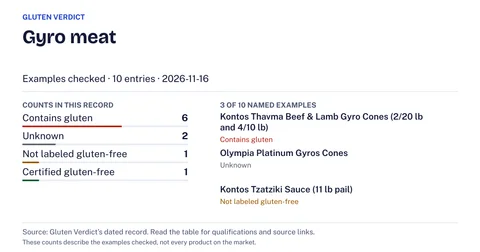 Gyro meatDepends on the product6 of 10 products we checked contain glutenchecked Nov 16, 2026
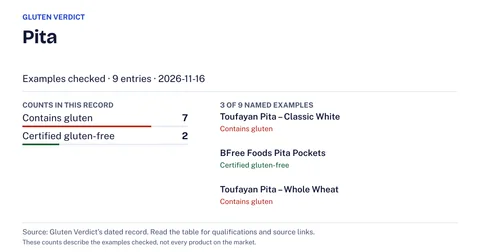 PitaContains glutenchecked Nov 16, 2026
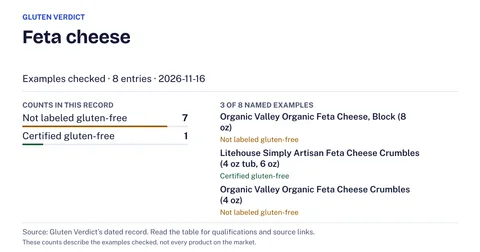 Feta cheeseNaturally gluten-freechecked Nov 16, 2026
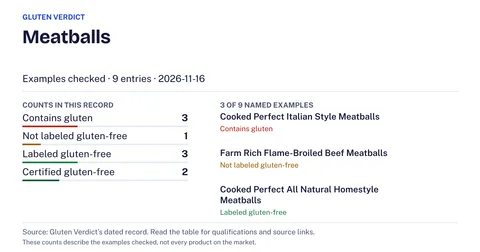 MeatballsDepends on the product3 of 9 products we checked contain gluten: Cooked Perfect Italian Style Meatballs, Cooked Perfect Restaurant Style Meatballs, and Farm Rich Homestyle Meatballschecked Nov 16, 2026
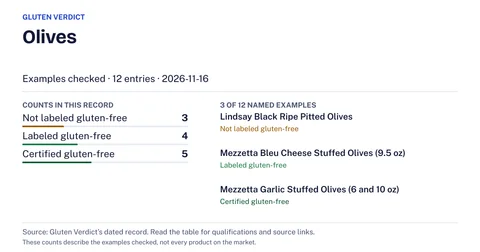 OlivesNaturally gluten-freechecked Nov 16, 2026
 PastaContains glutenchecked Nov 16, 2026
 BreadContains glutenchecked Nov 16, 2026
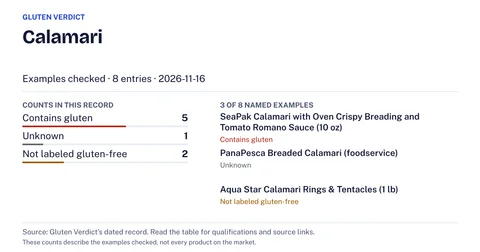 CalamariDepends on the product5 of 8 products we checked contain glutenchecked Nov 16, 2026
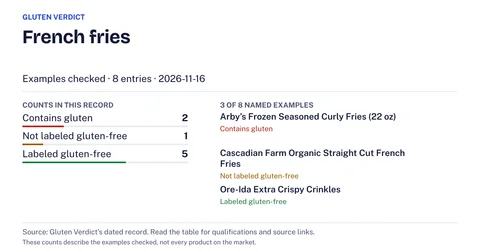 French friesDepends on the product2 of 8 products we checked contain gluten: Arby’s Frozen Seasoned Curly Fries (22 oz) and Checkers Frozen Crispy Seasoned Fries (28 oz)checked Nov 16, 2026
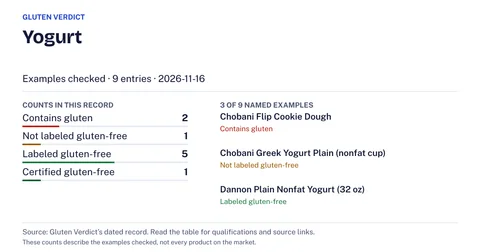 YogurtDepends on the product2 of 9 products we checked contain gluten: Chobani Flip Cookie Dough and Chobani Flip Cookies & Creamchecked Nov 16, 2026
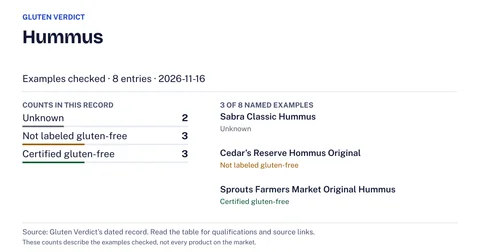 HummusDepends on the productchecked Nov 16, 2026
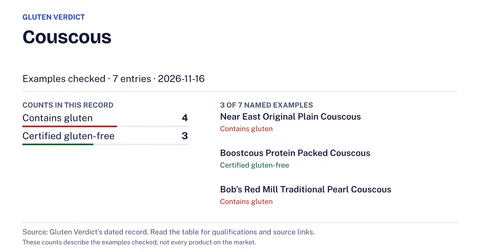 CouscousContains glutenchecked Nov 16, 2026
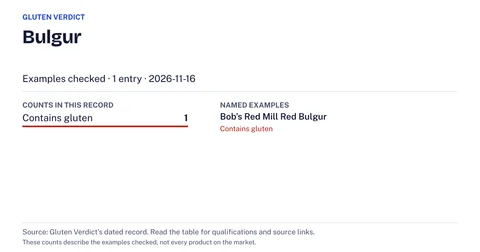 BulgurContains glutenchecked Nov 16, 2026
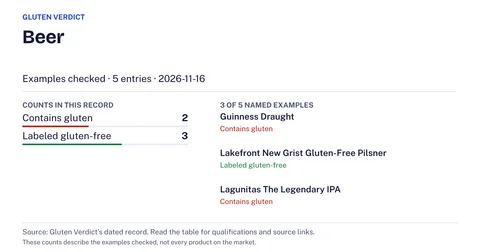 BeerDepends on the product2 of 5 products we checked contain gluten: Guinness Draught and Lagunitas The Legendary IPAchecked Nov 16, 2026
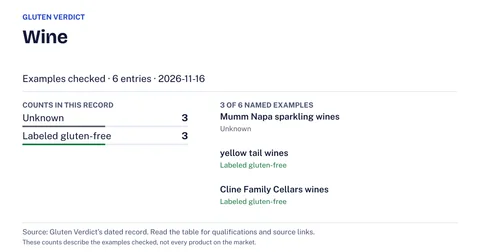 WineNaturally gluten-freechecked Nov 16, 2026
Questions people ask
Is “gluten-free” the same limit in Greece and the US?
Greece applies the EU limit of no more than 20 mg/kg1. FDA adopted less than 20 ppm as one criterion for a US “gluten-free” label19. The two rules are written differently and each applies to its own market.
Does a Greek restaurant have to tell me about gluten?
The Society says every Greek eating place has to inform you about allergens and possible contamination40, and the national decision requires the information for non-packaged food, including the possible, unintended presence of allergens11. Oral answers are allowed only under three conditions12.
Is ouzo gluten-free?
The Society says distilled spirits, ouzo among them, are gluten-free even when made from wheat or barley, because gluten does not pass into the distillate54. It advises a look at what is added to liqueurs and flavoured drinks after distillation56.
More in Travel: Europe
 Gluten-free in the Netherlands and Belgium: labels, fryers, waffles and beerWhat glutenvrij and sans gluten mean on a pack, what Dutch and Belgian counters must tell you, and the fryer, waffle and beer questions to ask.
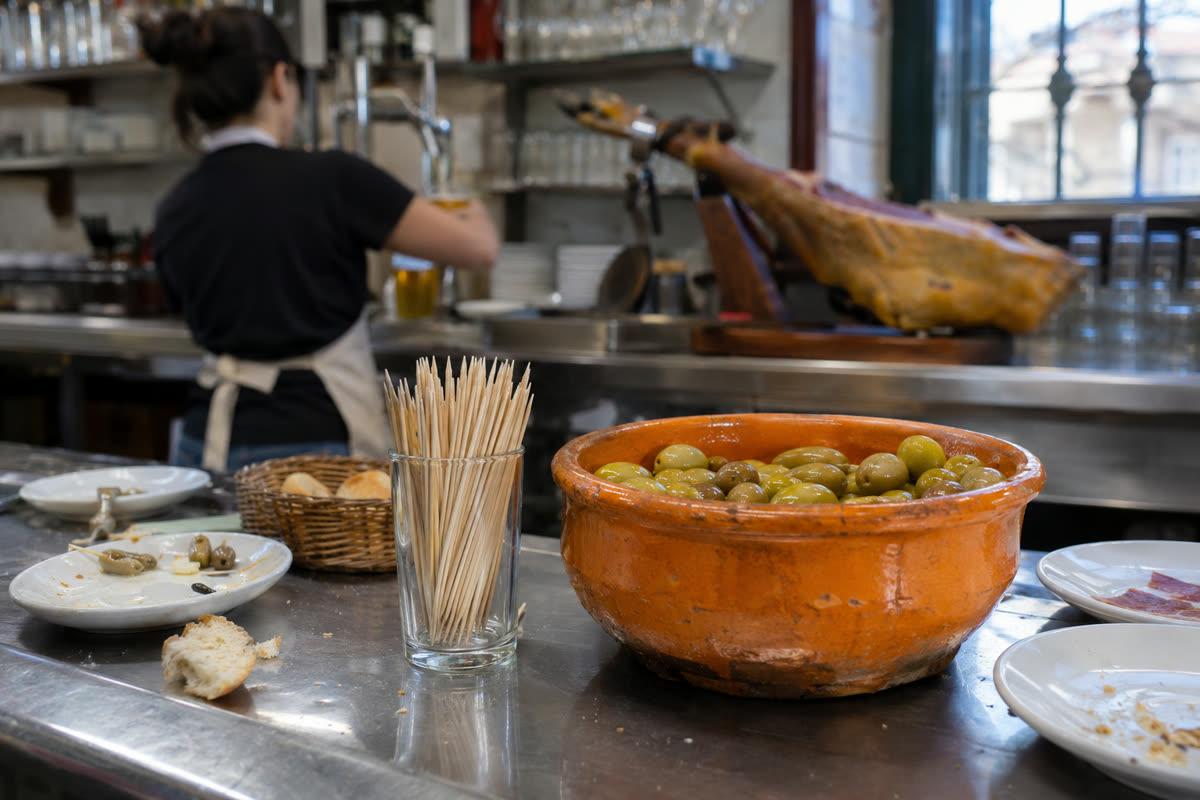 Gluten-free in Spain: what “sin gluten” means and what FACE coversWhat “sin gluten” means in Spain, what FACE’s marks and restaurant program say they cover, and which tapas need a question before you order.
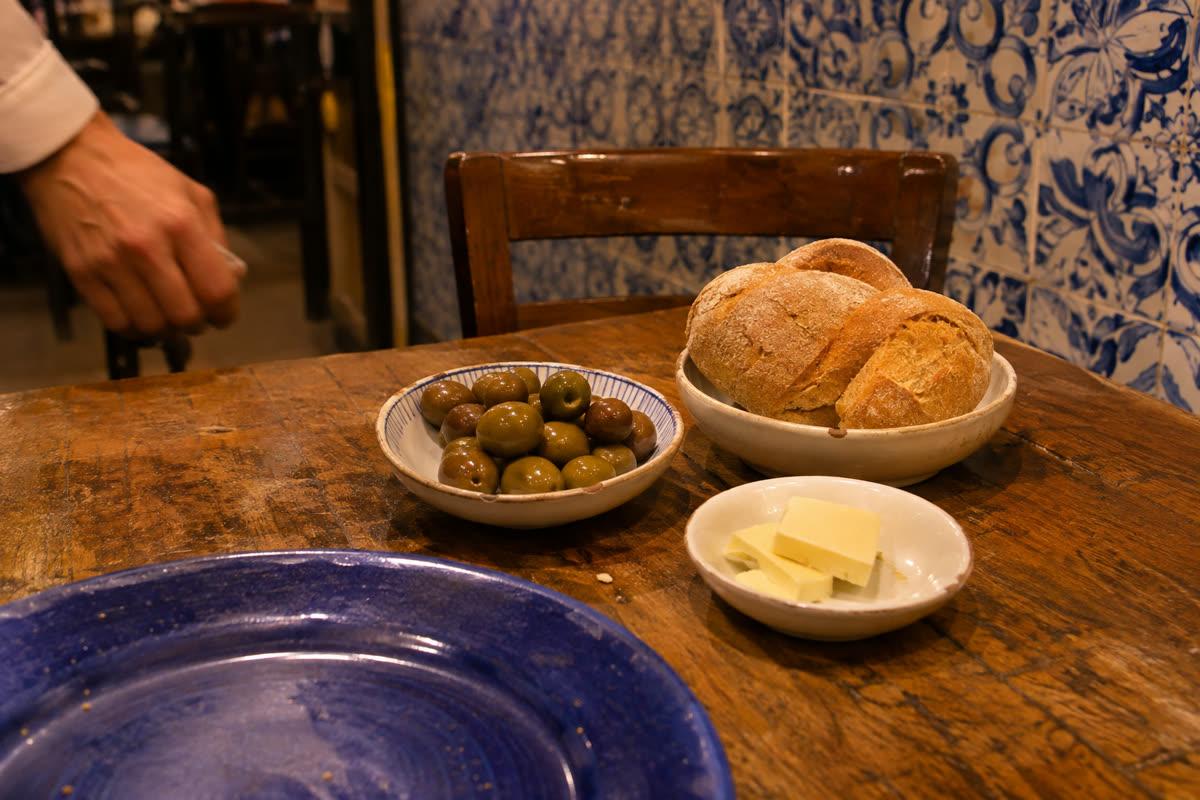 Gluten-free in Portugal: the couvert, pastelarias and what to askWhat «isento de glúten» means in Portugal, what you owe for the couvert, what restaurants must say about allergens, and what the celiac society advises.
 Gluten-free in Turkey: reading labels and menusTurkey’s gluten-free label rule, where wheat enters a Turkish menu (bulgur, şehriye, flour, mixes), and who to ask. Sources are Turkish and linked.
 Gluten-free in Central Europe: the rules in five countries and where wheat hides in the dishesWhich gluten-free rule covers a pack in Austria, Czechia, Hungary, Poland and Switzerland, and where wheat enters schnitzel, dumplings and sauces.
 Gluten-free in France: reading a pack, a menu and a “sans gluten” signWhat «sans gluten» means on a French pack, how restaurants must give allergen information, and what a bakery’s “sans gluten” sign does not promise.
Related guides
 Gluten-free and very low gluten on EU labels, and how allergens are highlightedWhat EU “gluten-free” and “very low gluten” claims permit, how cereals containing gluten are highlighted in ingredient lists, and the rules for loose food.
 Fine on bread in Europe? What it does and does not showWhat a trip where bread felt fine does and does not show about celiac disease, and how EU and US gluten-free label rules compare.
 Eating out with celiac disease: what to check, ask and watch forPlan a restaurant meal with celiac disease: what to check before you go, the questions to ask in order, how to read the answers, and what studies measured.
 Gluten words on European food labels, language by languageFind the ingredient list, the gluten-cereal name and the gluten-free claim on a European pack in 11 languages, using words from the EU’s own texts.
Sources
- [1, 8, 15, 17, 21, 23, 27] European Union (EUR-Lex), Regulation (EU) No 828/2014: gluten-free and very low gluten statements, checked Nov 17, 2026.
- [2, 3, 4, 5, 40, 43, 46, 54, 55, 56, 57] Hellenic Coeliac Society (Ελληνική Εταιρεία Κοιλιοκάκης), Συχνές ερωτήσεις για τη διατροφή χωρίς γλουτένη (FAQ on a gluten-free diet), checked Nov 17, 2026.
- [6, 7, 50, 51, 52] Celiac Disease Foundation, Sources of Gluten, checked Nov 17, 2026.
Read on 2026-11-17: the list headed “Common Foods That Contain Gluten” names, under Breads and Pastries, croissants, pita, naan, bagels, flatbreads, cornbread, potato bread, muffins, donuts and rolls; and under Pastas, raviolis, dumplings, couscous and gnocchi.
- [9, 10, 16, 20, 22, 28, 29, 30, 35, 36, 37, 38, 53, 62, 64] Hellenic Coeliac Society (Ελληνική Εταιρεία Κοιλιοκάκης), Ετικέτες τροφίμων και σήμανση «χωρίς γλουτένη» (food labels and the gluten-free claim), checked Nov 17, 2026.
- [11, 12, 34, 41] EFET (Hellenic Food Authority), National measures for allergen information on non-prepacked food (ministerial decision, PDF on efet.gr), checked Nov 17, 2026.
Read on 2026-11-17: Article 5(2) lists three conditions for giving the information orally: (a) a conspicuous sign on the premises that points to where the information is available or invites the consumer to ask staff; (b) the information also available in print or electronic form on the premises; (c) the information given before the sale, where the food is sold, by suitably trained staff or an electronic means, at no cost to the consumer.
- [13, 45] Parthenon Foods, Orzo, Kritharaki - Risoni Large, (Misko) 500g, checked Nov 17, 2026.
- [14, 44] The Fillo Factory, Classic Greek Spinach Pie, checked Nov 17, 2026.
- [18] Association of European Coeliac Societies (AOECS), AOECS members, checked Nov 17, 2026.
Read on 2026-11-17: the members page lists, under Greece, “Hellenic Coeliac Association” with a membership certificate, a link to licensed products and a website link to koiliokaki.com.
- [19] US Food and Drug Administration, Questions and Answers on the Gluten-Free Food Labeling Final Rule, checked Nov 17, 2026.
- [24, 26] European Union (EUR-Lex), Κανονισμός (ΕΕ) αριθ. 1169/2011, Annex II (Greek text as adopted), checked Nov 17, 2026.
- [25, 31, 32, 33, 39] European Union (EUR-Lex), Regulation (EU) No 1169/2011 on food information to consumers (text as adopted), checked Nov 17, 2026.
- [42, 59, 60, 63] Coeliac Youth of Europe (CYE), Travel Net: Greece, checked Nov 17, 2026.
Read on 2026-11-17: under “Greek cuisine has naturally gluten-free dishes! Ask about:” the page lists fresh grilled vegetables, unmarinated meat or fish, and potatoes cooked without flour or breadcrumbs.
Read on 2026-11-17: the page has a block headed “Greek coeliac dietary explanation” with a message in Greek followed by an English translation written for restaurant staff.
- [47, 48, 49] Hellenic Coeliac Society (Ελληνική Εταιρεία Κοιλιοκάκης), Προϊόντα χωρίς γλουτένη (gluten-free products), checked Nov 17, 2026.
- [58] Association of European Coeliac Societies (AOECS), Greece licensed gluten free products, checked Nov 17, 2026.
Read on 2026-11-17: the page headed “Greece Licensed Gluten Free Products” lists products with licence numbers beginning GR- (for example 3 Lentils Fusilli, Bread Mix, Buckwheat Flour and Chickpea Fusilli from Bioagros SA, updated 22 Sep 2021), with a brand filter naming Bioagros, Biokipos, Evergreen, GEORGE KOUNELAKIS, Gluten Free Organic, Hadjicosta Allantika, Niama and Welly.
- [61] Hellenic Coeliac Society (Ελληνική Εταιρεία Κοιλιοκάκης), Home page menu of koiliokaki.com, checked Nov 17, 2026.
Read the Society’s site menu on 2026-11-17: the top-level items are ΑΡΧΙΚΗ, ΚΟΙΛΙΟΚΑΚΗ, ΖΩΗ ΧΩΡΙΣ ΓΛΟΥΤΕΝΗ, ΣΥΛΛΟΓΟΣ, ΒΙΒΛΙΟΘΗΚΗ, ΓΙΝΕ ΜΕΛΟΣ, ΓΙΑ ΕΠΑΓΓΕΛΜΑΤΙΕΣ and ΕΠΙΚΟΙΝΩΝΙΑ, and none of the items under them is a restaurant directory.