Gluten-free in France: reading a pack, a menu and a “sans gluten” sign
Short answer
A French pack that says «sans gluten» holds no more than 20 mg of gluten per kg1, 2, and a French restaurant has to make written allergen information, gluten included, available for the dishes it serves3, 43. The allergen rule covers only substances deliberately put into a food4, and the EU text on gluten-free statements does not mention kitchens or bakeries5, so cross-contact is something you have to ask about.
- Gluten-free limit
- No more than 20 mg of gluten per kg of food as sold to the final consumer1; the regulation is directly applicable in every EU member state13
- Set by
- Commission Implementing Regulation (EU) No 828/20141
- Oats
- In a food presented as gluten-free, oats must be specially produced to avoid contamination by wheat, rye, barley or their crossbred varieties, and their gluten content cannot exceed 20 mg/kg20
- Celiac society
- Association Française des Intolérants au Gluten (AFDIAG)
Part of Travel: Europe, 19 guides
Key points
- The gluten grains carry French names on a pack: blé (also called froment), seigle, orge, avoine, and épeautre for spelt6, 7, 8.
- EU law counts oats among the cereals containing gluten that must be declared; the US allergen list names wheat but not barley, rye or oats7, 9.
- «Très faible teneur en gluten» (up to 100 mg/kg) is a different statement from «sans gluten» (up to 20 mg/kg)10, 2.
- AFDIAG, the French association of people intolerant to gluten, says the “sans gluten” mention has no mandatory regular controls, but a maker checked by the fraud authority has to prove under 20 mg/kg11.
- Service-Public lists bread, pastries, sandwiches and quiches sold unwrapped in a bakery among the foods whose allergens must be given12.
What «sans gluten» on a French pack commits the maker to
France applies the EU rule on gluten statements, Commission Implementing Regulation (EU) No 828/2014, which is directly applicable in every member state13. The English text of the statement is ‘gluten-free’; the French text calls it «sans gluten» and allows it only if the food as sold to the final consumer holds no more than 20 mg/kg of gluten1, 2.
A second wording, «très faible teneur en gluten» (‘very low gluten’ in the English text), is allowed only on a food made from, or containing, wheat, rye, barley or oats ingredients that were specially processed to reduce gluten, at no more than 100 mg/kg14, 10. It is not the same claim as «sans gluten». A maker may also place «convient aux personnes atteintes de la maladie cœliaque» (‘suitable for coeliacs’) next to these statements15, 16.
| United States (FDA) | France (EU rules; French rules for restaurants) | |
|---|---|---|
| Gluten-free claim | Any unavoidable presence of gluten must be less than 20 ppm17 | No more than 20 mg/kg in the food as sold1; AFDIAG writes the French limit as 20 mg/kg (=20 ppm)18 |
| Oats | Oats labeled gluten-free must contain less than 20 ppm19 | Oats in a gluten-free or very-low-gluten food must be specially produced to avoid contamination by wheat, rye or barley, and cannot exceed 20 mg/kg20 |
| Allergen list | Wheat is on the list; barley and rye are not9 | “Cereals containing gluten”: wheat, rye, barley, oats or their hybridised strains7 |
| “May contain” wording | Voluntary, and allowed beside a gluten-free claim if truthful and not misleading21 | Service-Public calls such warnings recommended but not mandatory22; AFDIAG says there is not yet a clear rule on them23 |
| Restaurants | FDA’s rule applies to packaged foods; FDA recommends that restaurants making a gluten-free claim match its definition24 | Written allergen information for dishes served on site3 |
The 20 mg/kg limit is about the food as sold1. The text of the regulation does not mention kitchens, bakeries or restaurants5. The wording is optional: Service-Public lists the gluten statements among voluntary mentions25. For other countries, see gluten-free labeling laws by country.
Words to look for on a French pack
EU law lists the allergens that must be declared, and in its French text the first entry of Annex II reads «Céréales contenant du gluten, à savoir blé (comme épeautre et blé de Khorasan), seigle, orge, avoine ou leurs souches hybridées»6, 7. Annex II has fourteen entries in all26.
In an ingredient list the allergen name has to stand out through font, style or background colour27. A pack with no ingredient list says ‘contains’ followed by the name28.
| English | French |
|---|---|
| Wheat | blé; AFDIAG’s card also names froment29, 8 |
| Spelt | épeautre6, 7 |
| Khorasan wheat | blé de Khorasan6, 7; AFDIAG’s card names KAMUT beside blé among the foods to avoid8 |
| Rye | seigle29 |
| Barley | orge29 |
| Oats | avoine29 |
| Wheat starch | amidon de blé30 |
AFDIAG’s card also lists hidden sources: «amidon de blé», «amidon de blé modifié», «extrait de malt» and «malt», which can turn up in some stock cubes, dried soups, sauce bases, charcuterie, spices, soy sauce and seasonings31. Our wheat starch page shows how we treat that ingredient.
“Peut contenir” and similar lines
Some makers add mentions such as «peut contenir des traces de gluten» or «fabriqué dans un atelier qui manipule ou utilise des aliments contenant du gluten»32. Service-Public describes such precautionary formulas as recommended but not mandatory, and says unintended allergen traces can arise in transport or through residual contact in the production chain22, 33. AFDIAG says there is not yet a clear regulation on these mentions, that they do not show whether the product contains traces or how much, and that without certainty it advises avoiding such products23.
The crossed-ear logo, «épi barré»
The «épi barré» (crossed ear) logo is the other mark to look for on a French pack. AFDIAG says the logo is protected by the European coeliac societies that belong to the AOECS and that in France AFDIAG owns it34. AFDIAG’s page for manufacturers sets these requirements:
- a maximum of 20 mg/kg of residual gluten in each product35;
- analysis of the finished product by independent COFRAC-accredited laboratories, using the ELISA R5 Méndez test36;
- an annual audit of the production sites to the AOECS Standard, by an independent body37;
- results sent to AFDIAG for checking at least once a year38.
On the pack, the logo comes with an identification code: the country of the maker’s head office, the maker’s code and the product number, with the word OATS added for products that contain oats39. All European countries use the same design, but the colour can differ, and the French logo is red40.
These are AFDIAG’s own statements about its logo. Nothing in this section is attributed to the French fraud authority (DGCCRF); we did not use its pages.
How a French restaurant or bakery has to give allergen information
Service-Public, the French government’s information site, says that when allergenic foods are in dishes served at a restaurant, the business must make written information on all the allergens available to customers: a slate, a notebook, a note on the menu, or any other system directly and freely accessible to customers3. Its page on bars and restaurants gives the short form: allergens in non-prepacked food go on the menu or in a notebook kept available to customers41.
The duty is wider than sit-down restaurants. Service-Public’s allergen page lists unwrapped cooked or processed foods, including bread, pastries, sandwiches and quiches in a bakery12, and foods prepacked for immediate sale, such as bags of biscuits and composed salads at a baker’s42. It adds that writing the word “allergènes” is not enough: the allergens must be named, and “gluten” is among its examples43.
On how the mentions must be displayed, Service-Public says the consumer should not have to look for the information or ask for it44. AFDIAG puts it as a choice: establishments must highlight the allergens on the menu or present the list on the customer’s request45. If you see no notebook, slate or menu note, ask.
Under EU law, for food offered without prepackaging, the allergen particulars are mandatory46, and member states may set national measures on the means through which they are made available47. The particulars cover any Annex II ingredient or processing aid still present in the finished product, even in altered form48.
Service-Public’s allergen page says the display duty does not apply to takeaway, only to meals offered for eating on site49. Its page on bars and restaurants says its display rules, which list the allergen line, apply to every type of restaurant service, takeaway and delivery included78. The two pages differ, so for a takeaway sandwich, ask.
What the allergen list does not tell you
Service-Public says the duty concerns only substances deliberately incorporated into the products4. So the written allergen information covers what the recipe includes on purpose4, not what the kitchen shares. Ask about the fryer, the grill, the toaster and the work surfaces.
AFDIAG’s restaurant network and its sticker
AFDIAG runs a referencing scheme for restaurants. It calls the network «Gluton» and lists the venues in a free app50. AFDIAG describes the member venues as having been trained in controlling contamination risks and as willing to welcome people on a gluten-free diet51.
According to AFDIAG’s pages, a venue joins by sending a registration form and its Kbis, the company registration document52, then follows a 2-hour remote training53. Trained venues are listed in AFDIAG’s directory and may put AFDIAG’s sticker on the shopfront and the menu, renewed each year54. AFDIAG’s page says a restaurant in the network may display the «sans gluten» sticker AFDIAG issues55, so a “sans gluten” sticker on a French restaurant door can be AFDIAG’s.
The pages describe training, a quiz, a practical part and an attestation56. They do not mention a visit to or inspection of the kitchen56. Read the sticker as “this venue completed AFDIAG’s training and is listed”, and still ask the questions in the card section below.
AFDIAG’s holiday guide (a PDF whose file name ends 2023) describes its listed restaurants as able to offer at least one gluten-free dish, with a sticker in the window57.
How the lists are kept
AFDIAG’s product directory, its list of «épi barré» brands, sits behind a member login: the address opens a login page, not a list58. The restaurant directory page describes the Gluton app but carries no list of venues and no date for the listing59. Check what the app shows for a venue before relying on it.
Bread, pastry, crepes and galettes: where the wheat is
AFDIAG’s card, printed in its holiday guide, lists as forbidden the flours of wheat, barley, oats and rye and their derivatives, and breads, croissants, brioches, cakes, tarts, biscuits, pizzas, quiches, noodles and pastas, certain soups, sauces and creams made with wheat flour, aperitif biscuits and breadcrumbs60. See our verdicts for bread, croissants and quiche.
For crepes and galettes, see our crepes verdict. The same card lists buckwheat («sarrasin») among the foods allowed, with rice, maize, soy and tapioca61. A galette called buckwheat on a menu still needs two questions: which flours are in the batter, and what is it cooked on.
Sauces, soups, fries and cheese
AFDIAG’s card names hidden sources such as wheat starch, modified wheat starch, malt extract and malt in some stock cubes, dried soups and sauce bases31, and lists certain soups, sauces and creams made with wheat flour among its forbidden foods60. AFDIAG’s advice when you are in doubt is to choose plain dishes such as grilled meat or fish, potatoes or rice, and vegetables or salad, and to ask to see the chef62; its holiday guide adds that it is generally best to avoid sauces63.
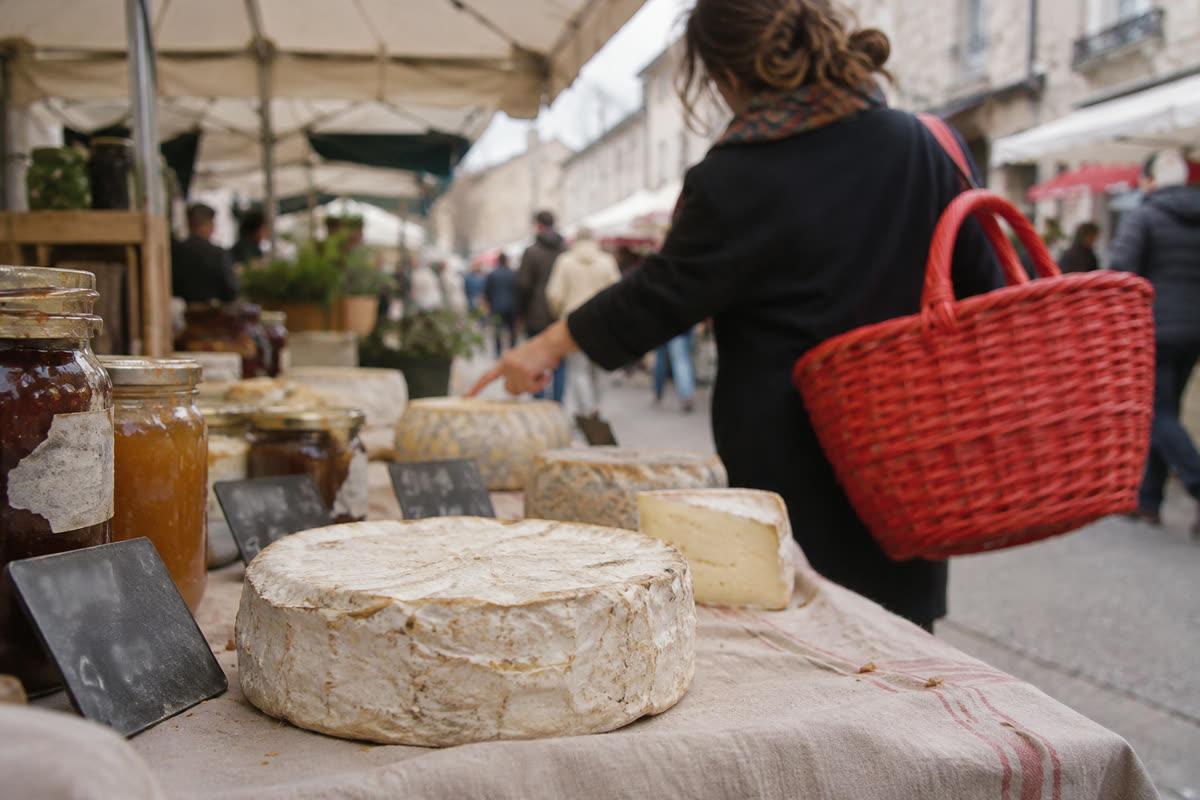
For fries, see our french fries verdict and ask whether the oil is shared with breaded foods. Brie and camembert have their own verdicts.
A French card to hand over
These lines are AFDIAG’s own wording, published on its travel page and in its holiday guide. We have not translated or changed any French.
| English (AFDIAG) | French (AFDIAG) |
|---|---|
| For medical reasons, I am not allowed to eat any products made of wheat, rye, barley, or oat and nothing breaded or thickened with flour. I may eat maize, rice, potatoes, vegetables, meat, etc., as well as soups and gravies thickened with starch of maize or potato flour.64 | Pour des raisons médicales, je n’ai pas le droit de manger de produits à base de blé, de seigle, d’orge ou d’avoine, ni de produits panés ou épaissis avec de la farine. Je peux manger du maïs, du riz, des pommes de terre, des légumes, de la viande, etc., ainsi que des soupes et des sauces épaissies avec de l’amidon de maïs ou de la farine de pomme de terre.65 |
| Does this product contain wheat, oats, barley or rye? | Ce produit contient-il du blé, de l'avoine, de l’orge ou du seigle?66 |
| Do you thicken the sauce with wheat flour or with corn flour? | Avez-vous lié cette sauce avec de la farine de blé ou avec de la farine de maïs ?67 |
| Without sauce please. | Sans sauce, s'il vous plaît.68 |
| Do you sell gluten-free foods? | Vendez-vous des produits sans gluten ?69 |
What the card leaves out: AFDIAG’s French sentence is about ingredients and flour used to bread or thicken. It does not mention shared equipment, fryers or work surfaces, although AFDIAG’s Italian sentence on the same page does ask about contact with gluten-containing food70. The French term for cross-contact on AFDIAG’s pages is «contamination croisée»71. Say the rest in English, point to the card and let the kitchen read it.
A bakery’s «sans gluten» sign: what it does and does not promise
Start with the law. The EU text allows information on the absence of gluten only through the statements in its annex and on that annex’s conditions72. For «sans gluten» the condition is no more than 20 mg/kg in the food as sold to the final consumer2.
What the law text does not do: it does not mention kitchens, bakeries or restaurants5, and the allergen display rule concerns only substances deliberately incorporated4. A «sans gluten» sign therefore reads as the maker’s claim about that product; it does not by itself say how the bakery keeps wheat flour away from it.
What backs the claim: AFDIAG says the mention has no mandatory regular controls, but if the fraud authority checks, the maker who used it must prove the product is under 20 mg/kg11. AFDIAG’s requirements for the «épi barré» logo add laboratory analysis of the finished product and an annual audit of the production site36, 37. AFDIAG’s restaurant sticker is a different thing again: it marks a venue that completed AFDIAG’s training54, and AFDIAG says the training and listing are open to any food business that asks, not only restaurants73.
Questions at the counter
- Is it wrapped and labeled? Foods prepacked for immediate sale carry an allergen mention42.
- Is the allergen information for this loaf or pastry written down where I can see it? Unwrapped bread and pastries are covered12.
- Is it made apart from the wheat products: separate surface, oven and tools, or only a different recipe?
- Does the maker have papers for the «sans gluten» claim? AFDIAG says that if the fraud authority checks, a maker who printed it has to prove the figure11.
- Does the pack or sign show the «épi barré» logo with its code39, or is it the shop’s own wording?
Shopping for packaged food
AFDIAG’s holiday guide, a PDF whose file name ends 2023, says gluten-free products («produits sans gluten») can be found in dietetic food stores and in most supermarkets under their own brands, naming Auchan, Carrefour, Casino, Leclerc and Monoprix, where brands such as Allergo, Gerblé and Schär also sit74. It warns that distributors can sell products that are not gluten-free too75.
Loose goods are a separate case. Service-Public says the allergen mention for bulk and self-service products must be written near the products where the consumer can see it76, while AFDIAG advises against buying loose goods because it is not possible to be sure there is no cross-contact71. AFDIAG adds that naturally gluten-free foods such as rice or lentils may have been contaminated in transport or storage, and recommends rinsing them well77.
Verdicts in this guide
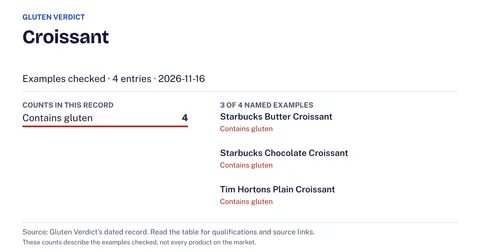 CroissantContains glutenchecked Nov 16, 2026
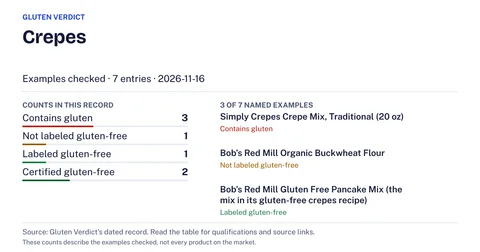 CrepesContains glutenchecked Nov 16, 2026
 BreadContains glutenchecked Nov 16, 2026
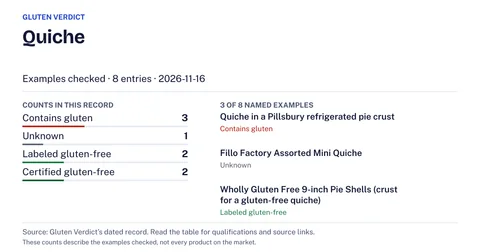 QuicheContains glutenchecked Nov 16, 2026
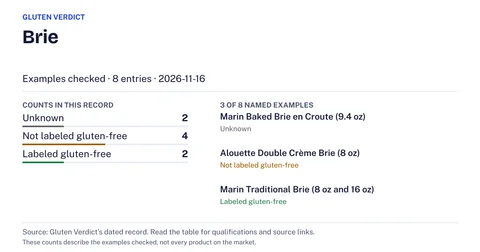 BrieNaturally gluten-freechecked Nov 16, 2026
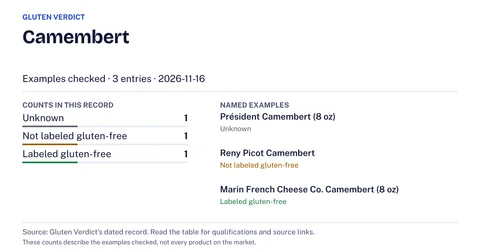 CamembertNaturally gluten-freechecked Nov 16, 2026
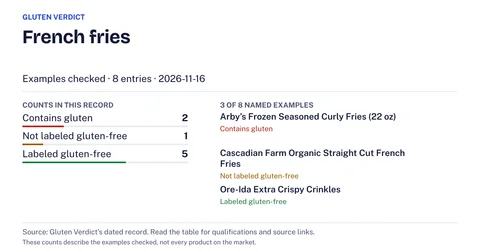 French friesDepends on the product2 of 8 products we checked contain gluten: Arby’s Frozen Seasoned Curly Fries (22 oz) and Checkers Frozen Crispy Seasoned Fries (28 oz)checked Nov 16, 2026
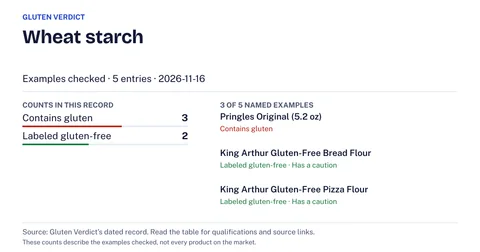 Wheat starchDepends on the product3 of 5 products we checked contain gluten: Pringles Original (5.2 oz), Jiffy Corn Muffin Mix, and Chex Mix Bold Garlic and Herbchecked Nov 16, 2026
Questions people ask
Is «sans gluten» the same as “gluten-free” in the US?
Both rules use the figure 20: FDA says any unavoidable gluten must be less than 20 ppm17, and the EU rule allows «sans gluten» at no more than 20 mg/kg2. AFDIAG writes the French limit as 20 mg/kg (=20 ppm)18.
Does a French restaurant have to tell me whether a dish contains gluten?
Service-Public says it must make written information on all allergens available to customers3. One Service-Public page says the duty covers meals eaten on site, not takeaway49; another says its display rules apply to takeaway too78.
What does «très faible teneur en gluten» mean?
It is a separate statement, allowed only on food made from gluten-grain ingredients specially processed to reduce gluten, at no more than 100 mg/kg10. «Sans gluten» is the 20 mg/kg statement2.
More in Travel: Europe
 Gluten-free in the Netherlands and Belgium: labels, fryers, waffles and beerWhat glutenvrij and sans gluten mean on a pack, what Dutch and Belgian counters must tell you, and the fryer, waffle and beer questions to ask.
 Gluten-free in Spain: what “sin gluten” means and what FACE coversWhat “sin gluten” means in Spain, what FACE’s marks and restaurant program say they cover, and which tapas need a question before you order.
 Gluten-free in Greece: what the label and the taverna promise, and what to askWhat “gluten-free” means in Greece, where wheat hides in Greek dishes such as gyro, orzo and pies, and what to ask at a taverna.
 Gluten-free in Italy: what the AIC program covers and what to askWhat “senza glutine” means in Italy, what AIC’s restaurant program asks of a kitchen, and the questions to ask in a restaurant, pharmacy or shop.
 Gluten-free in Croatia and the Balkans: which rule applies where, and where wheat enters the dishesWhich gluten-free rule applies in Croatia, Serbia, Bosnia and Montenegro, how to read the claim, and where wheat enters burek, ćevapi and palačinke.
 Gluten-free in Portugal: the couvert, pastelarias and what to askWhat «isento de glúten» means in Portugal, what you owe for the couvert, what restaurants must say about allergens, and what the celiac society advises.
Related guides
 Gluten-free and very low gluten on EU labels, and how allergens are highlightedWhat EU “gluten-free” and “very low gluten” claims permit, how cereals containing gluten are highlighted in ingredient lists, and the rules for loose food.
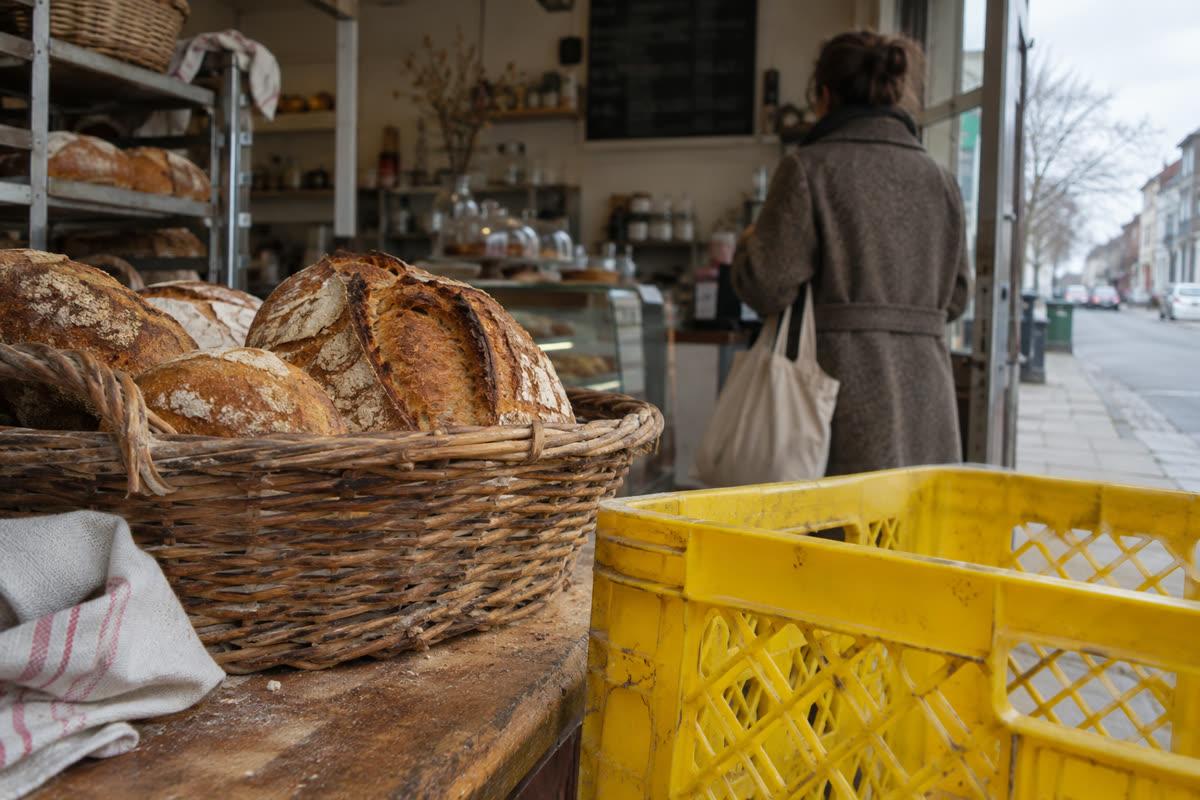 Fine on bread in Europe? What it does and does not showWhat a trip where bread felt fine does and does not show about celiac disease, and how EU and US gluten-free label rules compare.
 Gluten words on European food labels, language by languageFind the ingredient list, the gluten-cereal name and the gluten-free claim on a European pack in 11 languages, using words from the EU’s own texts.
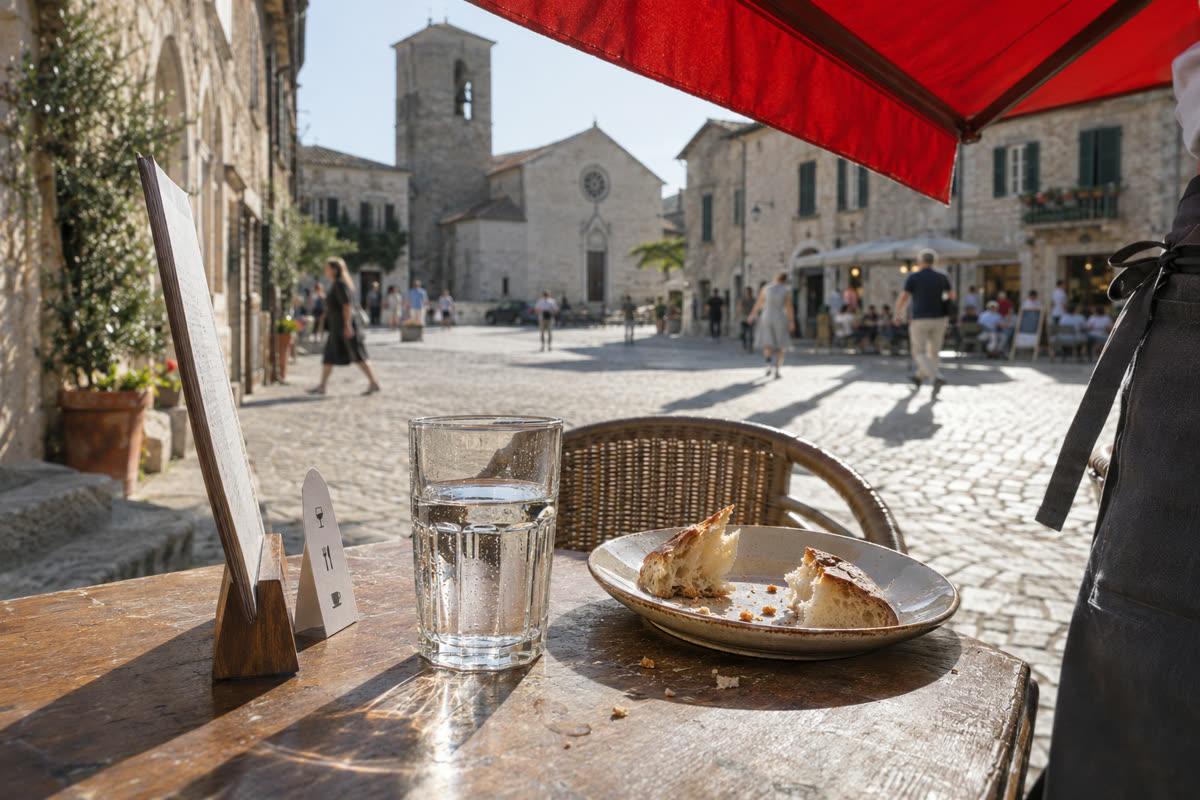 What a European restaurant must tell you about gluten, country by countryWhether restaurants in France, Germany, Austria, Italy, Spain and the UK must show allergens in writing or may answer aloud, and what to ask.
Sources
- [1, 5, 13, 14, 15, 20, 72] European Commission (EUR-Lex), Regulation (EU) No 828/2014 on information about the absence or reduced presence of gluten (English), checked Nov 17, 2026.
Read on 2026-11-17: the articles and the annex of Regulation (EU) No 828/2014 set conditions for the ‘gluten-free’ and ‘very low gluten’ statements on the food as sold to the final consumer; the text does not mention kitchens, bakeries or restaurants.
- [2, 10, 16] European Commission (EUR-Lex), Règlement d’exécution (UE) n° 828/2014, text in French, checked Nov 17, 2026.
- [3, 4, 12, 22, 25, 33, 42, 43, 44, 49, 76] Service-Public Entreprendre (French government), Quels allergènes doivent être mentionnés sur un produit alimentaire ?, checked Nov 17, 2026.
- [6] European Commission (EUR-Lex), Règlement (UE) n° 1169/2011, annexe II (consolidated text, French), checked Nov 17, 2026.
- [7, 26, 27, 28, 46, 47, 48] European Commission (EUR-Lex), Regulation (EU) No 1169/2011, Annex II (consolidated text, English), checked Nov 17, 2026.
Read on 2026-11-17: Annex II, headed “Substances or products causing allergies or intolerances”, has fourteen numbered entries, from 1 “Cereals containing gluten” to 14 “Molluscs and products thereof”.
- [8, 29, 30, 31, 57, 60, 61, 63, 66, 67, 68, 69, 74, 75] AFDIAG (Association Française des Intolérants au Gluten), Holiday guide for coeliacs (PDF, file name 2023), checked Nov 17, 2026.
Read on 2026-11-17: on the copy of AFDIAG’s membership card, the box headed “ALIMENTS INTERDITS” lists wheat, barley, oats and rye flours and their derivatives; breads, croissants, brioches, cakes, tarts, biscuits, pizzas, quiches, noodles and various pastas; certain soups, sauces and creams made with wheat flour; aperitif biscuits; and breadcrumbs.
- [9] US Food and Drug Administration, Food Allergen Labeling and Consumer Protection Act of 2004 (FALCPA), checked Nov 17, 2026.
- [11, 34] AFDIAG (Association Française des Intolérants au Gluten), Logo « épi barré », checked Nov 17, 2026.
- [17, 19, 21, 24] US Food and Drug Administration, Questions and Answers on the Gluten-Free Food Labeling Final Rule, checked Nov 17, 2026.
- [18, 23, 32, 39, 40, 45, 71, 77] AFDIAG (Association Française des Intolérants au Gluten), Lors de vos achats en magasin, checked Nov 17, 2026.
Read on 2026-11-17: under “Produits certifiés avec le logo « épi barré »”, the list after “Les produits portant ce logo disposent tous d’un code d’identification composé des informations suivantes” names the country where the maker has its head office (for example FR for France), the code given to the maker, the product number, and the word OATS for products containing oats (example OATS-FR-YYZZ).
- [35, 36, 37, 38] AFDIAG (Association Française des Intolérants au Gluten), Description du logo « épi barré » (espace professionnel), checked Nov 17, 2026.
- [41, 78] Service-Public (French government), Réglementation dans un bar ou un restaurant, checked Nov 17, 2026.
- [50] AFDIAG (Association Française des Intolérants au Gluten), L’AFDIAG lance Gluton : une application pour les régimes sans gluten, checked Nov 17, 2026.
- [51, 55, 59] AFDIAG (Association Française des Intolérants au Gluten), Annuaire des restaurants labelisés dans l’application Gluton, checked Nov 17, 2026.
Read on 2026-11-17: the page describes the Gluton app and its network; its text has no list of restaurants and no date for the listing.
- [52, 53] AFDIAG (Association Française des Intolérants au Gluten), Obtenir le référencement restaurant, checked Nov 17, 2026.
- [54, 56, 73] AFDIAG (Association Française des Intolérants au Gluten), Description de la formation restaurant, checked Nov 17, 2026.
Read on 2026-11-17: the page describes a registration form, a 2-hour training, an assessment in two parts (a knowledge quiz and “Mise en pratique”) and an attestation issued at the end; the page and the “Obtenir le référencement restaurant” page do not mention a visit to, or an inspection of, the venue’s kitchen.
- [58] AFDIAG (Association Française des Intolérants au Gluten), Annuaire des produits sans gluten, checked Nov 17, 2026.
Read on 2026-11-17: the address of AFDIAG’s “Annuaire des produits sans gluten” opens a page titled “Connexion adhérent - AFDIAG”, a members’ login form; the page text has no product list.
- [62, 64, 65, 70] AFDIAG (Association Française des Intolérants au Gluten), Lors de vos voyages, checked Nov 17, 2026.
Read on 2026-11-17: the French sentence AFDIAG supplies names wheat, rye, barley and oats and says nothing breaded or thickened with flour; it does not mention shared equipment, fryers or work surfaces. The Italian sentence on the same page does ask for food not in direct or indirect contact (“stesso piano di lavoro/cottura, stessi utensili per la lavorazione”) with gluten-containing food.