Gluten-free in Denmark, Sweden, Norway, Finland and Iceland
Short answer
Denmark, Sweden and Finland apply the EU gluten-free rule directly, Norway applies the same text through the EEA Agreement, and Iceland’s food agency sets the same limit, so “gluten-free” on a Nordic pack means no more than 20 mg of gluten per kg1, 2, 19, 22. Check, in this order:
- The claim word on the pack: glutenfri in Danish, Swedish and Norwegian, gluteeniton in Finnish and glútenlaus in Icelandic9, 10, 12, 11, 22.
- The ingredient list: the EU list of gluten cereals names wheat, rye, barley and oats, and the texts we read print it in Danish, Swedish, Finnish and Norwegian5, 13, 14, 15, 16.
- Oats: under the EU text, in a food called gluten-free they must be specially produced and at no more than 20 mg/kg4.
- The menu mark: a Finnish G can mean gluten-free, contains gluten, or can be made gluten-free41.
Part of Travel: Europe, 19 guides

Key points
- The US rule sets any unavoidable presence of gluten at below 20 ppm7; the EU limit is no more than 20 mg/kg2.
- The EU defines gluten to include oats3; the US definition of a gluten-containing grain lists wheat, rye and barley8.
- Licorice sweets usually have wheat flour added, according to the Finnish Coeliac Society45.
- Norway requires mandatory food information in Norwegian or a language spelled similarly20.
Whose gluten-free rule applies in each country?
Regulation (EU) No 828/2014 is binding in its entirety and directly applicable in all EU Member States1. The agencies we read say the same for the three EU countries in this guide: Sweden’s Livsmedelsverket says the rules for producing and labeling gluten-free food are common across the EU31, and the Finnish Food Authority calls the regulation binding in all respects and applicable in all member states38. Denmark’s Fødevarestyrelsen gives the same ceiling for food marketed as glutenfri26.
Norway applies the same texts through the EEA Agreement: its own food information regulation states that the EEA Agreement’s entry for Regulation 828/2014 applies as Norwegian regulation, with the adaptations the agreement sets19. In Iceland, MAST says that Icelandic Regulation 1294/2014 implements EU Regulation 1169/201121, and its gluten page sets the same 20 mg/kg limit for “glútenlaus”22 while referring to Regulation 828/201423.
| Country | Where the rule comes from | Limit for “gluten-free” |
|---|---|---|
| United States | 21 CFR 101.917 | Any unavoidable presence of gluten below 20 ppm, which the rule equates to below 20 mg gluten per kg of food7 |
| Denmark | EU Regulation 828/2014, directly applicable1 | No more than 20 mg gluten per kg26 |
| Sweden | EU Regulation 828/2014, named on Livsmedelsverket’s page33 | No more than 20 mg gluten per kg32 |
| Norway | EEA Agreement, applied as Norwegian regulation19 | At most 20 mg/kg12 |
| Finland | EU Regulation 828/201438 | No more than 20 mg/kg39 |
| Iceland | Icelandic Regulation 1294/2014 for food information21; 828/2014 cited on MAST’s gluten page23 | No more than 20 mg/kg22 |
The wording differs slightly: the US text says any unavoidable presence must be below 20 ppm7, the EU text says no more than 20 mg/kg2. We have not read any source that compares the two further, so this guide does not call them identical.
Which regulator and celiac society pages cover each country?
These are the pages we opened on 2026-11-17 and what each one covers. Open the society page for your country before you travel.
| Country | Regulator page | Celiac society page |
|---|---|---|
| Denmark | Fødevarestyrelsen, “Glutenfri” (claim rules) and “Oplysning om allergener” (allergen information)26, 29 | Dansk Cøliaki Forening, “Rejs med cøliaki” (travel, language cards)53 |
| Sweden | Livsmedelsverket, “Gluten, celiaki och spannmålsallergi”31 | Svenska Celiakiförbundet, “Resa med celiaki” (translation cards)55 |
| Norway | The regulation text on Lovdata, §§ 1b and 219, 20 | Norsk cøliakiforening, “Reisetips” and “Glutenfree tourist in Norway”56, 58 |
| Finland | Ruokavirasto (Finnish Food Authority), gluten-free and very low gluten food38 | Keliakialiitto, “Briefly in English” with travel tips for Finland48 |
| Iceland | MAST, “Glúten” and “Ofnæmis- og óþolsvaldar”22, 21 | Selíaksamtök Íslands, seliak.is, “Að ferðast erlendis með selíak”52 |
Two sites would not open from our tools, so nothing here rests on them: Norway’s Mattilsynet and gluten.is, the website AOECS links for its Icelandic member. AOECS, the European federation, lists that member as Selíak- og glútenóþolssamtök Íslands, and the Norwegian, Swedish, Danish and Finnish members under the names above59. We have not confirmed that the body behind seliak.is is the same Icelandic member.
What words to look for on a pack and a menu
The texts we read print the claim word and the heading for the gluten cereals in each country’s language; for Iceland we read MAST’s pages. The English heading in the EU list is “Cereals containing gluten”, and it names wheat, rye, barley and oats5.
| Country | Gluten-free claim | Heading for gluten cereals |
|---|---|---|
| Denmark | glutenfri9 | Glutenholdige kornprodukter13 |
| Sweden | glutenfri10 | Spannmål som innehåller gluten14 |
| Norway | glutenfri12 | Kornslag som inneholder gluten16 |
| Finland | gluteeniton11 | Gluteenia sisältävät viljat15 |
| Iceland | glútenlaus22 | MAST lists wheat, rye, barley, oats, spelt and kamut as the gluten cereals24 |
Norway’s language rule: mandatory food information has to be in Norwegian or a language whose spelling resembles Norwegian20.
Finnish menus: the letter G
In Finland, marking gluten-free dishes on a menu is voluntary for restaurants and cafes, and the law does not say how a dish must be marked40. The Finnish Coeliac Society says a G on a Finnish menu usually means the dish is gluten-free, but the same mark can mean the dish is gluten-free, that it contains gluten, or that it can be made gluten-free41. The same society says that on ferries menu markings can differ from what is usual in Finland, for example by marking the dishes that contain gluten42. Ask what the mark means before you order.
Rye bread and sourdough: is it a gluten grain?
Rye is a gluten grain under both rule sets: the EU list of gluten cereals names it5, and so does the US definition of a gluten-containing grain8. The Icelandic society says rye is the basis of rúgbrauð and is also used in crackers and health foods49.
Sourdough does not change that. Sweden’s Livsmedelsverket answers “No” to the question whether sourdough-leavened bread is gluten-free, and says that for a gluten-intolerant person this applies to bread baked on ordinary wheat, rye, barley or spelt flour, sourdough bread included35. For the wider question of European bread, see bread in Europe and the gluten myth and our bread verdict.
We did not read a source on Swedish crispbread, Norwegian lompe and lefse, or Finnish rye breads by name, so this guide says nothing about them: read the ingredient list on each pack.
Meatballs, sausages, fish and sauces: where does the wheat sit?
Livsmedelsverket notes that the gluten cereals can also be found in sauces, sausages and fish fingers36. The Icelandic society lists batter for deep frying among the places gluten is found, and says it is often found in gravies, soy sauces, spice mixes and sausages50.
Denmark’s Fødevarestyrelsen gives two examples of ordinary foods that can be marketed as glutenfri: frikadeller or medister sausage made with potato or millet flour in place of wheat breadcrumbs, wheat flour or rye flour27, and fish fillets breaded with millet flour or a soy product instead of breadcrumbs28. So breadcrumbs, flour and batter are what to ask about in such a dish.
Our verdicts for meatballs, gravy, breadcrumbs and hot dogs show the sources we read for each, with the date we read them. They are about products we checked, not about what a Nordic kiosk or kitchen uses.
Oats: how the EU rule, the societies and the US definition differ
The EU rule defines gluten as a protein fraction from wheat, rye, barley, oats or their crossbred varieties3. A food presented as gluten-free that contains oats must use oats specially produced, prepared or processed to avoid contamination by wheat, rye, barley or their crossbred varieties, and those oats cannot exceed 20 mg/kg of gluten4. The US definition of a gluten-containing grain lists wheat, rye, barley and their crossbred hybrids, and does not list oats8.
| Country | What we read |
|---|---|
| Denmark | The Danish text of the EU rule requires specially produced oats at no more than 20 mg per kg in a food called glutenfri17 |
| Sweden | Livsmedelsverket says oats specially produced so they are free of contamination by wheat, rye or barley may be labeled glutenfri34 |
| Norway | The Norwegian text of the EU rule requires specially produced oats at no more than 20 mg/kg in a food called glutenfritt18 |
| Finland | Keliakialiitto says only oat products labeled gluten-free are used in a gluten-free diet, and calls oat a gluten-free grain44 |
| Iceland | MAST sets the same specially-produced, 20 mg/kg condition for oats in glútenlaus food25; the Icelandic society advises celiac patients never to eat a product containing oats unless the ingredient list says the oats are certified gluten-free51 |
The societies and the EU text are worded differently, so read the row for the country you are in. For more on oats, see oats and celiac disease and our oatmeal verdict.
Licorice and sweets
The Finnish Coeliac Society says licorice itself is a root plant that is entirely gluten-free, and that wheat flour is usually added to licorice sweets, so they contain gluten; it adds that gluten-free licorice sweets are on the market45. That is one Finnish society’s statement about licorice sweets in general, and it does not say which countries’ sweets it covers, so read the ingredient list on any licorice you buy. Our licorice verdict shows the sources we read for it.
May-contain lines and loose food
- Ingredient lists: the Finnish Coeliac Society says wheat, rye or barley used in a product is named clearly in the ingredient list, and it names exceptions to that46.
- May-contain lines: Livsmedelsverket says the Swedish “kan innehålla spår av” line is a warning statement and that at present no limits exist for products carrying it37. The Finnish Coeliac Society says a product carrying a Finnish warning such as “Saattaa sisältää vehnää” (may contain wheat) is generally not recommended in a gluten-free diet, and that it makes an exception for sweets with such a warning47.
- Loose food: the EU rule makes the allergen particulars mandatory for food offered without prepackaging, while leaving other particulars to national measures6. In Denmark, allergen information for such food can be given in writing or orally; for prepacked food it is always in writing29. If a Danish business gives it orally, a visible sign must say customers can ask the staff30.
For restaurant allergen rules across Europe, see European restaurant allergen information rules.
Can you get a translation card for each Nordic language?
Each society offers something different, and we do not write translated phrases ourselves.
- Denmark: Dansk Cøliaki Forening offers language cards in Danish and in the languages of Danes’ preferred travel destinations53; the page names seven languages and none of the other Nordic languages54.
- Sweden: members of Svenska Celiakiförbundet have access to translation cards in about 40 languages55.
- Norway: Norsk cøliakiforening lists a translations item for restaurants abroad, marked for members only56.
- Finland: Keliakialiitto publishes a printable card for kitchens in Finnish43. The text states that the holder follows a strict gluten-free diet and asks the kitchen to prepare the food with clean utensils, apart from products containing gluten43.
- Iceland: the Icelandic society says cards that explain celiac disease in the local language can be found online and in apps52.
Norway’s society recommends that visitors check with hotels in advance and say on arrival that they need a gluten-free breakfast58. It says many entries on its restaurant map are recommendations from members, and that it has no follow-up or certifying system for the map57.
Verdicts in this guide
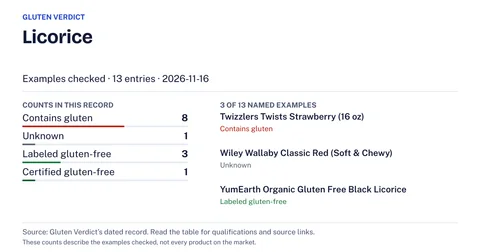 LicoriceDepends on the product8 of 13 products we checked contain glutenchecked Nov 16, 2026
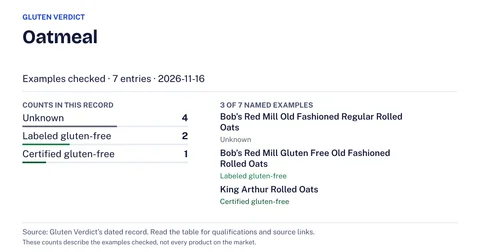 OatmealDepends on the productchecked Nov 16, 2026
 BreadContains glutenchecked Nov 16, 2026
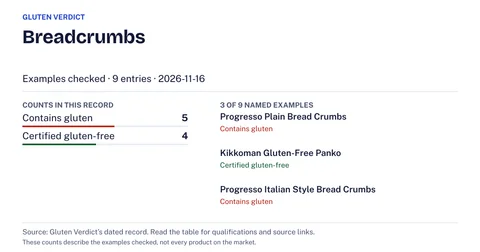 BreadcrumbsContains glutenchecked Nov 16, 2026
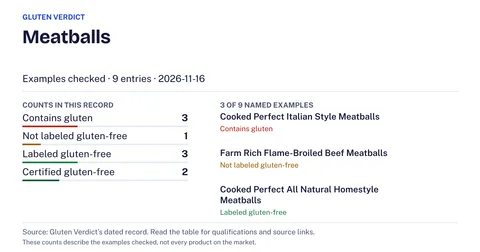 MeatballsDepends on the product3 of 9 products we checked contain gluten: Cooked Perfect Italian Style Meatballs, Cooked Perfect Restaurant Style Meatballs, and Farm Rich Homestyle Meatballschecked Nov 16, 2026
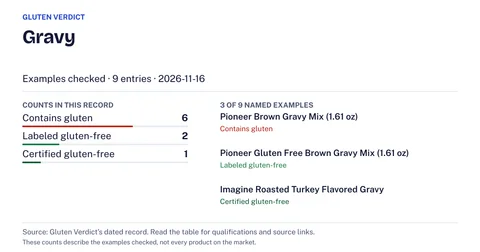 GravyDepends on the product6 of 9 products we checked contain glutenchecked Nov 16, 2026
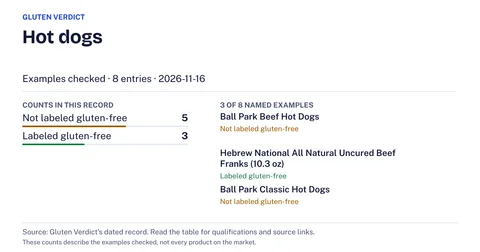 Hot dogsDepends on the productchecked Nov 16, 2026
Questions people ask
Does glutenfri mean the same in Denmark, Sweden and Norway?
On the limit, yes: the Danish26, Swedish32 and Norwegian12 sources we read each give no more than 20 mg of gluten per kg.
Are oats allowed in a gluten-free Nordic product?
Under the EU text, oats in a food presented as gluten-free must be specially produced and at no more than 20 mg/kg4. Sweden’s Livsmedelsverket says such oats may be labeled glutenfri34.
Does a G on a Finnish menu mean gluten-free?
Usually, but not always: the Finnish Coeliac Society says the same mark can mean gluten-free, contains gluten, or can be made gluten-free41.
More in Travel: Europe
 Gluten-free in Turkey: reading labels and menusTurkey’s gluten-free label rule, where wheat enters a Turkish menu (bulgur, şehriye, flour, mixes), and who to ask. Sources are Turkish and linked.
 Gluten-free in Central Europe: the rules in five countries and where wheat hides in the dishesWhich gluten-free rule covers a pack in Austria, Czechia, Hungary, Poland and Switzerland, and where wheat enters schnitzel, dumplings and sauces.
 What a European restaurant must tell you about gluten, country by countryWhether restaurants in France, Germany, Austria, Italy, Spain and the UK must show allergens in writing or may answer aloud, and what to ask.
 Gluten-free on a trip through several European countries: borders, trains, hostels and supermarketsA packing and shopping plan for a multi-country Europe trip: what each border lets you carry, what the EU label rule covers, and a check for each stop.
 Gluten-free in the Netherlands and Belgium: labels, fryers, waffles and beerWhat glutenvrij and sans gluten mean on a pack, what Dutch and Belgian counters must tell you, and the fryer, waffle and beer questions to ask.
 Gluten-free in Ireland: labels, pub rules, Guinness and the Crossed Grain symbolWhat Irish labels, pub allergen rules and the Crossed Grain symbol say about gluten, and what Guinness lists, so a US traveler knows what to check.
Related guides
 Gluten-free and very low gluten on EU labels, and how allergens are highlightedWhat EU “gluten-free” and “very low gluten” claims permit, how cereals containing gluten are highlighted in ingredient lists, and the rules for loose food.
 Fine on bread in Europe? What it does and does not showWhat a trip where bread felt fine does and does not show about celiac disease, and how EU and US gluten-free label rules compare.
 Gluten-free oats by country: where the claim is allowed and where it is barredWhether oats can carry a gluten-free claim in the US, Canada, EU, UK, Australia and New Zealand, in each regulator’s own words.
 Oats and celiac disease: what a gluten-free oat label does and does not tell youWhat FDA’s rule covers for oats, how makers get oats to the gluten-free limit, what avenin studies found, and what to ask your doctor.
Sources
- [1, 2, 3, 4] European Commission (EUR-Lex), Regulation (EU) No 828/2014: gluten-free and very low gluten statements, checked Nov 17, 2026.
- [5, 6] European Commission (EUR-Lex), Regulation (EU) No 1169/2011 on food information to consumers (consolidated text), checked Nov 17, 2026.
- [7, 8] eCFR (US Government Publishing Office), 21 CFR 101.91, Gluten-free labeling of food, checked Nov 17, 2026.
- [9, 17] European Commission (EUR-Lex), Regulation (EU) No 828/2014: gluten-free and very low gluten statements (Danish text), checked Nov 17, 2026.
- [10] European Commission (EUR-Lex), Regulation (EU) No 828/2014: gluten-free and very low gluten statements (Swedish text), checked Nov 17, 2026.
- [11] European Commission (EUR-Lex), Regulation (EU) No 828/2014: gluten-free and very low gluten statements (Finnish text), checked Nov 17, 2026.
- [12, 16, 18, 19, 20] Lovdata (Norwegian regulation text), Forskrift om matinformasjon til forbrukerne (matinformasjonsforskriften), annex to Regulation 828/2014, checked Nov 17, 2026.
- [13] European Commission (EUR-Lex), Regulation (EU) No 1169/2011 on food information to consumers (consolidated text) (Danish text), checked Nov 17, 2026.
- [14] European Commission (EUR-Lex), Regulation (EU) No 1169/2011 on food information to consumers (consolidated text) (Swedish text), checked Nov 17, 2026.
- [15] European Commission (EUR-Lex), Regulation (EU) No 1169/2011 on food information to consumers (consolidated text) (Finnish text), checked Nov 17, 2026.
- [21] MAST (Icelandic Food and Veterinary Authority), Ofnæmis- og óþolsvaldar (allergens), checked Nov 17, 2026.
- [22, 23, 24, 25] MAST (Icelandic Food and Veterinary Authority), Glúten (gluten-free and reduced gluten statements), checked Nov 17, 2026.
- [26, 27, 28] Fødevarestyrelsen (Danish Veterinary and Food Administration), Glutenfri, checked Nov 17, 2026.
- [29, 30] Fødevarestyrelsen (Danish Veterinary and Food Administration), Oplysning om allergener, checked Nov 17, 2026.
- [31, 32, 33, 34, 35, 36, 37] Livsmedelsverket (Swedish Food Agency), Gluten, celiaki och spannmålsallergi, checked Nov 17, 2026.
- [38, 39] Ruokavirasto (Finnish Food Authority), Gluten-free and very low gluten food, checked Nov 17, 2026.
- [40, 41, 43] Keliakialiitto (Finnish Coeliac Society), Turvallisesti ravintoloissa ja kahviloissa (restaurants and cafes), checked Nov 17, 2026.
- [42] Keliakialiitto (Finnish Coeliac Society), Matkailu ja kielikäännökset (travel and translations), checked Nov 17, 2026.
- [44] Keliakialiitto (Finnish Coeliac Society), Erilaiset viljat (grains), checked Nov 17, 2026.
- [45] Keliakialiitto (Finnish Coeliac Society), Usein kysyttyä tuotteista ja ainesosista (FAQ on products and ingredients), checked Nov 17, 2026.
- [46, 47] Keliakialiitto (Finnish Coeliac Society), Tarkista ainesosat (check the ingredients), checked Nov 17, 2026.
- [48] Keliakialiitto (Finnish Coeliac Society), Briefly in English, checked Nov 17, 2026.
- [49, 50, 51] Selíaksamtök Íslands (seliak.is), Hvað er glúten? (what is gluten), checked Nov 17, 2026.
- [52] Selíaksamtök Íslands (seliak.is), Að ferðast erlendis með selíak (travelling abroad), checked Nov 17, 2026.
- [53, 54] Dansk Cøliaki Forening, Rejs med cøliaki (travel with coeliac disease), checked Nov 17, 2026.
Read on 2026-11-17: the list of language cards on the page names Dansk, Engelsk, Tysk, Fransk, Spansk, Italiensk and Græsk (Danish, English, German, French, Spanish, Italian, Greek); no Swedish, Norwegian, Finnish or Icelandic card is named on the page.
- [55] Svenska Celiakiförbundet, Resa med celiaki: översättningskort (translation cards), checked Nov 17, 2026.
- [56] Norsk cøliakiforening (NCF), Reisetips (travel tips), checked Nov 17, 2026.
- [57, 58] Norsk cøliakiforening (NCF), Glutenfree tourist in Norway, checked Nov 17, 2026.
- [59] AOECS (Association of European Coeliac Societies), Members, checked Nov 17, 2026.
Read on 2026-11-17: the member list names Dansk Cøliaki Forening for Denmark, Suomen Keliakialiitto ry for Finland, Selíak- og glútenóþolssamtök Íslands for Iceland, Norsk cøliakiforening for Norway and Svenska Celiakiförbundet for Sweden; the Website link on the Iceland entry points to gluten.is.