Gluten-free ranges at European supermarkets, as the chains describe them
Short answer
Chains differ in what they publish, so check three things before you choose where to shop:
- A list: Sainsbury’s publishes product guidance lists for gluten1, while Mercadona says it has none2 and Migros says it keeps no list of all gluten-free products3.
- An online filter, which follows the chain’s own definition: Albert Heijn’s counts products with no gluten-containing ingredients or at most 20 ppm4, and Sainsbury’s also leaves out products with a may-contain-gluten line5.
- The mark on the pack: “gluten-free” is a legal claim, no more than 20 mg/kg in the EU rule6, while a chain’s own logo or a certifier’s seal is a separate mark that the chain describes7, 8.
Part of Travel: Europe, 19 guides

Key points
- EU law and the GOV.UK guidance for England, Northern Ireland and Wales give the same two limits: no more than 20 mg/kg for gluten-free and no more than 100 mg/kg for very low gluten6, 9, 10, 11.
- Sainsbury’s publishes lists; Mercadona says it has none and points to the label2, and Migros says it keeps no list of all gluten-free products and points to a certifier’s overview3, 12.
- Tesco’s Free From shopping list has separate menu entries for gluten-free and wheat-free, egg-free and milk-free, so a place in the zone does not say which allergen a product is free from13.
- An online filter is only as complete as the data behind it: Albert Heijn says an item can be missing from a filter if a supplier did not give full information14.
- Migros says its aha! seal counts for people with coeliac disease only when the word glutenfrei sits next to it8.
What each chain says, side by side
We read each chain’s own pages on 2026-11-17. What follows is what the chain says about itself, not a test of its shelves, and the pages change, so the date of each reading is in the sources list. For what a food type is, and when it is gluten-free, start from every verdict, A to Z.
| Chain | What it publishes | What it says the claim, filter or mark covers |
|---|---|---|
| Mercadona (Spain) | No lists; the label is the source2. Own logo on packed gluten-free products7; in May 2024 it counted more than 1,533 Hacendado gluten-free products, most carrying the logo15. | Under 20 parts per million, never “cero gluten” (zero), on a 2015 news page16. |
| Carrefour (Spain) | A No Gluten! range, plus a “sin gluten” pictogram on the pack17. One page counts more than 700 products18; another counts more than 300 and ties them to the list FACE edits19. | Carrefour’s page says these products ensure the absence of gluten and avoid cross-contamination18. |
| Carrefour (France) | A No Gluten range page that names pasta, bread, cereal, pastries and biscuits20, 21. | No definition of the claim in the text we could read21. |
| Tesco (UK) | A Free From zone and a Free From shopping list, with menu entries for gluten-free and wheat-free, egg-free and milk-free13. | Its page describes brands free from gluten, wheat, milk and egg, so the zone is wider than gluten22. |
| Sainsbury’s (UK) | Product guidance lists for gluten (a PDF), updated monthly1, 23, and a Gluten Free filter5. | The filter leaves out gluten-based ingredients including oats, and products with a may-contain-gluten line5. |
| Albert Heijn (Netherlands) | A Zonder gluten filter in the app and web shop4, 24. | No gluten-containing ingredients, or at most 20 ppm4. |
| Migros (Switzerland) | No full list; an overview of its aha!-certified range on the certifier’s site3, 12. | Own-brand items with the glutenfrei claim are certified and carry the crossed-grain symbol25; Migros reports a Swiss limit of 20 mg/kg26. |
The rule behind the words
In the EU, information about the absence of gluten may be given only through the statements set out in the regulation’s annex27. “Gluten-free” requires no more than 20 mg/kg of gluten in the food as sold6; “very low gluten” allows up to 100 mg/kg and applies to food with ingredients specially processed to reduce gluten9. Mercadona and Albert Heijn put the figure as less than 20 parts per million16, 28.
GOV.UK’s technical guidance sets out the same two limits, and says it applies to England, Northern Ireland and Wales10, 11. It also says a gluten-free statement can sit next to a may-contain line such as may contain wheat29. In Switzerland, Migros reports that Swiss food legislation (LIV) lets a food be called glutenfrei at up to 20 mg/kg26.
A chain’s own logo, a free-from zone or a certifier’s seal is not automatically that legal claim: Tesco’s zone covers more than gluten22, and Migros says an aha! seal alone is not enough for people with coeliac disease8. That is why the table above separates them. Our guides cover the pack itself: gluten-free and very low gluten on EU labels and UK gluten-free labelling.
Spain: Mercadona and Carrefour
Mercadona answers the list question directly. Its customer FAQ says it has no lists of products without gluten, milk or egg, and advises against checking that information in databases or in website photos because it cannot vouch that they are current. It says ingredient, allergen and trace information is always available and current on each product’s label2.
What Mercadona does offer is its own logo on packed gluten-free products, which it says is meant to make shopping easier7. By its May 2024 count it offered more than 1,533 Hacendado gluten-free products, and most carry the logo15. A 2015 news page defines the claim as under 20 ppm and says it never means zero gluten16. The count will have moved since, so treat it as a sign of range, not a current figure.
Carrefour España presents a No Gluten! range and says more than 700 products from its brands ensure the absence of gluten and avoid cross-contamination; it tells you to look for the “sin gluten” pictogram on the pack18, 17. A second Carrefour page counts more than 300 and ties them to the list FACE edits19. Because the two counts differ, rely on the pictogram and the label, not on a number. What “sin gluten” and FACE cover is in our Spain guide.
Carrefour France has a No Gluten range page that names pasta, bread, cereal, pastries and biscuits20, 21. The text that loaded for us defines nothing about the claim21; for French packs see our France guide.
UK: Tesco and Sainsbury’s
Tesco groups specialist food under Free From, and its shopping list menu names Free From, Gluten-free & wheat-free, Egg-free, Branded favourites, Award-winners and Milk-free13. Its Free From page says the range includes brands free from gluten, wheat, milk and egg22. A place in the zone therefore does not tell you which allergen a product is free from. GOV.UK’s guidance refers to a ‘free from’ statement for a particular allergen30, so look for the gluten-free wording on the product itself.
Sainsbury’s publishes product guidance lists for gluten; the gluten list says it features all products that are suitable for people avoiding gluten1, divided by category31. They leave out the in-store bakery, service deli, hot food counters, fresh meat and fish counters, café and salad bar32, and Sainsbury’s advises shoppers with allergies to avoid everything sold from those counters33. Its help page says the lists are updated monthly23 and recommends checking the packaging before you buy34.
Its online Gluten Free filter is stricter than the legal claim. It leaves out gluten-based ingredients such as wheat, barley, rye or oats, and products with a line like may contain gluten or wheat5. GOV.UK’s guidance says a gluten-free statement can sit beside such a line29, so a product could carry the claim and still be left out of this filter. UK rules are in our UK labelling guide and UK travel guide.
Netherlands: Albert Heijn
Albert Heijn’s diet filter defines Zonder gluten as products without gluten-containing ingredients, or with a gluten content of at most 20 ppm4. A footnote says that when it knows of cross-contamination (kruisbesmetting), this is stated on the pack35. The same page warns that an item can be missing from a filter, because filtering runs on an algorithm and a supplier may not have given full information14.
A news page of 28 August 2025 says the chain added a freezer shelf of gluten-free bakery products in 270 stores36 and an improved search with gluten-free filters in the app and web shop24. Its gluten-free page groups products under headings that include bakery, gluten-free cereals, and pasta and meals37.
One thing on Dutch packs can look like a mistake. The chain’s product-information page says the law obliges it to declare wheat as an allergen whatever the amount, so it declares gluten-free wheat: wheat appears in bold, while the product contains less than 20 ppm of gluten38. Wheat in bold on a glutenvrij pack is, on the chain’s account, this practice. The chain’s dietitian page says gluten-free products show a crossed-grain logo and/or the words glutenvrij or vrij van gluten on the label39.
Switzerland: Migros
Migros’s July 2026 leaflet on gluten intolerance says Migros keeps no list of all products that suit a gluten-free diet3. It points to an overview of the aha!-certified range on the certifier’s website12.
Migros says its own-brand products carrying the glutenfrei claim are certified by Service Allergie Suisse and bear the crossed-grain symbol25, and that other makers’ products are marked in text as Glutenfrei or Glutenfree40.
Migros says that an aha! seal alone is not enough for people with coeliac disease: only aha! products that also carry the word glutenfrei, or glutenfrei, mit Hafer, are suitable8.
Not every product is in every store. Migros says so41, and says its online shop shows availability store by store42.
Bread, pasta and cereal: where each chain’s pages put them
Our verdicts explain when bread, pasta, cereal, crackers, cookies, flour and rice flour are and are not gluten-free. The chain pages show where the gluten-free versions sit.
- Mercadona: a January 2025 page has sections for sliced bread, a loaf, hamburger buns, baguette, breadcrumbs, breadsticks, toasts and crackers43. It puts the loaf and the baguette in the bakery (Horno) section44, 45, and warns that in the Canary Islands the classic sliced bread comes in a different pack46.
- Carrefour France: its range page names pasta, bread, cereal, pastries and biscuits21.
- Tesco: Free From items are shelved under names such as Free From Noodles, Pasta & Cous Cous, Free From Cereal, Free From Premium Loaves and Free From Biscuits & Cookies13.
- Sainsbury’s: its list is divided by category, such as Fresh Meal Solutions, Dairy and Biscuits31.
- Albert Heijn: its gluten-free page has sections for Schär gluten-free bread, gluten-free cereals, and pasta and meals37, and a freezer shelf of gluten-free bakery products in 270 stores36.
Before you shop
- Choose the chain for where you are staying, open its gluten-free page, and note whether it gives you a list, a filter or a mark.
- Use a list or filter to build a shortlist, then check the pack: Mercadona names the label as its current source2, Sainsbury’s recommends checking packaging34, and Albert Heijn says a filter can miss items14.
- On the pack, read the legal words first, then the chain’s own logo, then the emphasised allergens in the ingredients. Gluten-free and very low gluten on EU labels shows how.
- Skip the counters that are not packed: Sainsbury’s advises shoppers with allergies to avoid its in-store bakery, deli and hot food counters33. If you are cooking in a rental, see setting up a gluten-free kitchen in a vacation rental.
Verdicts in this guide
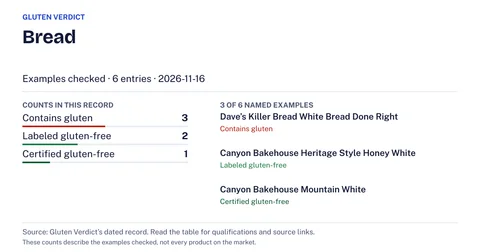 BreadContains glutenchecked Nov 16, 2026
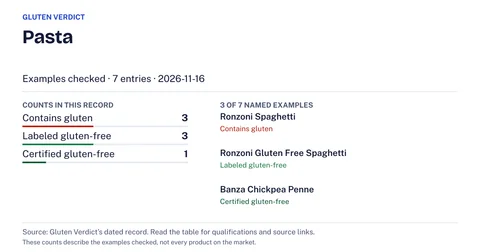 PastaContains glutenchecked Nov 16, 2026
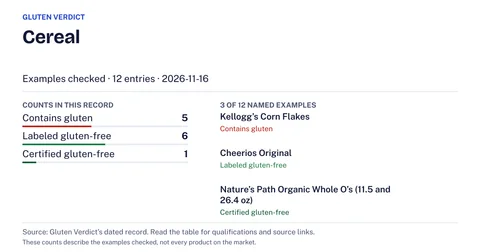 CerealDepends on the product5 of 12 products we checked contain glutenchecked Nov 16, 2026
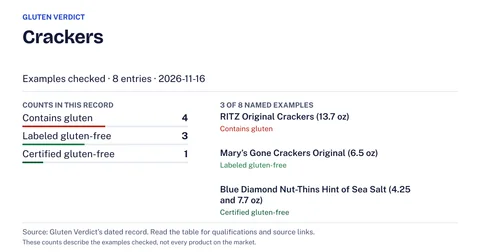 CrackersDepends on the product4 of 8 products we checked contain glutenchecked Nov 16, 2026
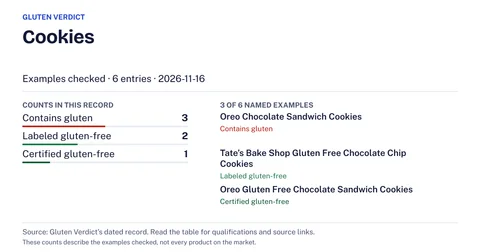 CookiesContains glutenchecked Nov 16, 2026
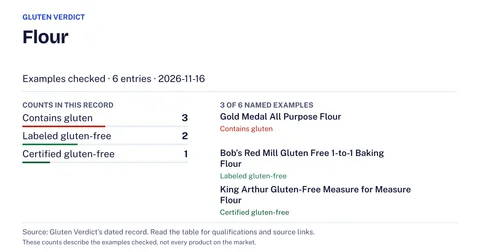 FlourContains glutenchecked Nov 16, 2026
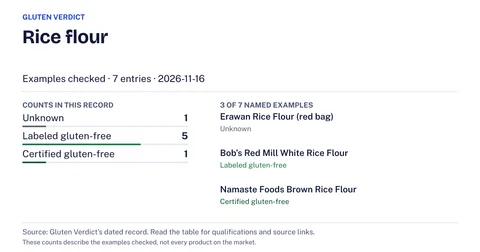 Rice flourNaturally gluten-freeBuy it labeled gluten-freechecked Nov 16, 2026
Questions people ask
Do European supermarkets publish a list of gluten-free products?
It varies. Sainsbury’s publishes product guidance lists1; Mercadona says it has none2, and Migros says it keeps no list of all gluten-free products3.
Is Tesco’s Free From zone the same as gluten-free?
Not by itself. Tesco says its range includes brands free from gluten, wheat, milk and egg22, and its Free From list has separate menu entries for gluten-free and wheat-free, egg-free and milk-free13. Look for the gluten-free wording on the product.
Why is wheat in bold on a gluten-free Albert Heijn product?
The chain says the law makes it declare wheat as an allergen whatever the amount, so it shows wheat in bold for a product it describes as containing less than 20 ppm of gluten38.
Is the aha! seal on a Migros product enough?
Migros says no: only aha! products that also carry the word glutenfrei, or glutenfrei, mit Hafer, are suitable for people with coeliac disease8.
More in Travel: Europe
 Gluten-free on a trip through several European countries: borders, trains, hostels and supermarketsA packing and shopping plan for a multi-country Europe trip: what each border lets you carry, what the EU label rule covers, and a check for each stop.
 Gluten-free in Turkey: reading labels and menusTurkey’s gluten-free label rule, where wheat enters a Turkish menu (bulgur, şehriye, flour, mixes), and who to ask. Sources are Turkish and linked.
 Gluten-free in the Netherlands and Belgium: labels, fryers, waffles and beerWhat glutenvrij and sans gluten mean on a pack, what Dutch and Belgian counters must tell you, and the fryer, waffle and beer questions to ask.
 Gluten-free in Italy: what the AIC program covers and what to askWhat “senza glutine” means in Italy, what AIC’s restaurant program asks of a kitchen, and the questions to ask in a restaurant, pharmacy or shop.
 Gluten-free in Greece: what the label and the taverna promise, and what to askWhat “gluten-free” means in Greece, where wheat hides in Greek dishes such as gyro, orzo and pies, and what to ask at a taverna.
 Gluten-free in Central Europe: the rules in five countries and where wheat hides in the dishesWhich gluten-free rule covers a pack in Austria, Czechia, Hungary, Poland and Switzerland, and where wheat enters schnitzel, dumplings and sauces.
Related guides
 Gluten words on European food labels, language by languageFind the ingredient list, the gluten-cereal name and the gluten-free claim on a European pack in 11 languages, using words from the EU’s own texts.
 Gluten-free and very low gluten on EU labels, and how allergens are highlightedWhat EU “gluten-free” and “very low gluten” claims permit, how cereals containing gluten are highlighted in ingredient lists, and the rules for loose food.
 UK gluten-free labelling: the legal rules, Natasha’s Law and the Crossed GrainWhat UK law requires on allergen and gluten-free labels, what Natasha’s Law added for food packed on site, and how the Crossed Grain mark differs.
 Setting up a gluten-free kitchen in a vacation rentalAsk the host, pack the few items that hold gluten, and wash a rental kitchen with soap and water, with each step tied to a source.
Sources
- [1, 31, 32] Sainsbury’s, Product Guidance List: gluten (PDF), checked Nov 17, 2026.
- [2] Mercadona, Customer FAQ: do you have lists of gluten-free products?, checked Nov 17, 2026.
- [3, 8, 12, 26, 40, 41, 42] Migros, Merkblatt Glutenintoleranz / Zöliakie (leaflet, July 2026), checked Nov 17, 2026.
- [4, 14, 35] Albert Heijn, Filters op producten (diet filters), checked Nov 17, 2026.
- [5] Sainsbury’s, Dietary and lifestyle filters, checked Nov 17, 2026.
- [6, 9, 27] European Commission (EUR-Lex), Commission Implementing Regulation (EU) No 828/2014 on gluten-free statements, checked Nov 17, 2026.
- [7, 16] Mercadona, News page of 3 July 2015: labelling of Mercadona gluten-free foods, checked Nov 17, 2026.
- [10, 11, 29, 30] GOV.UK (Food Standards Agency guidance), Food allergen labelling and information requirements technical guidance, checked Nov 17, 2026.
- [13] Tesco, Free From shopping list, checked Nov 17, 2026.
Read on 2026-11-17: the Explore Free From menu on Tesco’s Free From shopping list names Free From, Gluten-free & wheat-free, Egg-free, Branded favourites, Award-winners and Milk-free. Items on the Free From list are shelved under names such as Free From Noodles, Pasta & Cous Cous, Free From Cereal, Free From Premium Loaves and Free From Biscuits & Cookies.
- [15] Mercadona, News page of 16 May 2024: a menu for coeliacs every day, checked Nov 17, 2026.
- [17, 18] Carrefour España, Carrefour No Gluten! (own brands), checked Nov 17, 2026.
- [19] Carrefour España, Carrefour No Gluten! more information, checked Nov 17, 2026.
- [20, 21] Carrefour France, Carrefour No Gluten range page, checked Nov 17, 2026.
Read on 2026-11-17: the first screen of the page headed Carrefour No Gluten lists products including Pâtes Fusilli, Penne Rigate and spaghetti sans gluten, Céréales choco noisettes sans gluten bio, and Tartines sans gluten au maïs et riz. The page says it offers Pâtes, pains, céréales, viennoiseries, biscuits ... un large choix de produits du quotidien au meilleur prix. The text that loaded gives no definition of the sans gluten claim; a heading Contrôlés et labellisés appears with no text under it.
- [22] Tesco, Free From zone, checked Nov 17, 2026.
- [23, 33, 34] Sainsbury’s, Help: allergens and intolerances in own-brand and in-store prepared products, checked Nov 17, 2026.
- [24, 36] Albert Heijn, News page of 28 August 2025: gluten-free alternatives, checked Nov 17, 2026.
- [25] Migros, Glutenfreies Migros-Sortiment wächst (iMpuls page), checked Nov 17, 2026.
- [28, 38] Albert Heijn, Customer FAQ: product information, checked Nov 17, 2026.
- [37] Albert Heijn, Glutenvrije producten (category page), checked Nov 17, 2026.
Read on 2026-11-17: the page headed Glutenvrije producten has sections headed Bakkerij, Broodbeleg, Schär glutenvrij brood en afbakbrood, Glutenvrije ontbijtgranen, Tussendoortjes, Pasta en maaltijden, Kruiden en sauzen, Verspakketten, Vlees, kip, vis en vega(n), Diepvries and Bakproducten.
- [39] Albert Heijn, Glutenvrij eten: wat is het en waar begin je?, checked Nov 17, 2026.
- [43, 44, 45, 46] Mercadona, Food tips page of 7 January 2025: gluten-free breads, checked Nov 17, 2026.
Read on 2026-11-17: the page dated 7 January 2025 has sections headed Pan de molde clásico o pan de molde de cereales sin gluten; Pan de hogaza sin gluten; Pan de hamburguesa sin gluten; Baguette sin gluten; Pan rallado sin gluten; Picos sin gluten; and Pan tostado y crackers sin gluten.