Gluten-free at the farmers market and in a CSA box: what to ask each producer
Short answer
Whole fresh fruit, vegetables and eggs are naturally gluten-free, as is meat without additives or some seasonings1, 2. Anything prepared, pre-seasoned or altered from its natural state could contain gluten, so it needs the producer’s ingredient list and answers about the kitchen3:
- Whole produce, eggs and plain cuts of meat: no ingredient questions, and rinse the produce4.
- Baked goods, sauces, jams, pasta and spice blends: ask who made it, what is in it and what else is made in that kitchen5, 6. Cottage food laws, the rules for foods made in home kitchens, differ from state to state13.
- Grains and flour: ask whether the fields and equipment are shared with gluten-containing grains8, 62. Dry beans: sort them and rinse them60.
- A CSA box: treat the base share as produce and each add-on as its own stall, because CSAs can include meat, dairy, eggs and processed products from the farm9.
Part of Grocery shopping and meal planning, 15 guides

Key points
- Fresh fruit, vegetables and eggs are naturally gluten-free1, and a “gluten-free” claim isn’t required on a package, so a bin of produce without one is not a warning10.
- Anything prepared, pre-seasoned or altered from its natural state could contain gluten, which is why the stalls selling it are where questions belong3.
- Wheat is on the federal allergen list; barley and rye are not11. A home-baker’s “Contains: wheat” line says nothing about barley or malt, so ask for the whole ingredient list.
- Grains bought straight from a farm can pick up gluten through shared fields, harvesting and storage, so ask about shared equipment before you buy12, 8.
- Cottage food labeling differs by state7, 13: Michigan’s page asks for a full ingredient list14, while Texas’s page asks for any major allergen used15.
Which stalls need no label?
Whole fresh fruit, vegetables and eggs are naturally gluten-free, according to FDA1. NIDDK says the same of meat without additives or some seasonings2. GIG explains why a farm stand helps: food bought straight from the source is more likely to be in its natural form, without added ingredients that could contain gluten16, and shopping this way means real, fresh food that does not require reading a label17.
A missing “gluten-free” claim is not a warning. FDA notes that a “gluten-free” claim isn’t required on a food package, so it may not appear even when the food is gluten-free10. The “Contains” provision of federal allergen law is worded for a food that is “not a raw agricultural commodity”18.
“No label needed” is not “no care needed.” GIG says food from a farm still carries some risk of gluten exposure19. Produce is less likely to be exposed to gluten grains, but GIG says it should be rinsed anyway4. Meat is less likely to be exposed because it is typically processed, stored and transported on different equipment than grains20, but GIG notes that meat may have seasonings or other ingredients added21.
| Stall | Starting point | What to check |
|---|---|---|
| Whole fresh fruit and vegetables | Naturally gluten-free1 | Rinse them4. Cut, seasoned or packed-with-something-else items belong in the next section3. |
| Eggs | Naturally gluten-free1. See our eggs verdict. | GIG says most dairy products, like eggs and milk, are gluten-free if sold or prepared without anything that contains gluten22. An egg dish with other ingredients is a prepared food: use the next section. |
| Plain cuts of meat | Naturally gluten-free without additives or some seasonings2 | Pre-seasoned meats and self-basting poultry are on the Celiac Disease Foundation’s list of foods that may contain gluten23. |
| Potatoes and corn | See our potatoes verdict and corn verdict. | Check for toppings or coatings on cooked ears and potatoes sold hot. |
| Honey and maple syrup | See our honey verdict and maple syrup verdict. | GIG says to check for added flavors and whether the honey was processed in a shared facility with gluten-containing products24. |
Which stalls need questions, and why?
GIG’s advice is to ask: a farmers market, roadside stand or farm storefront may sell more than produce, and some prepared foods such as cheeses, jellies and honey could be gluten-free, but anything prepared, pre-seasoned or otherwise altered from its natural state could contain gluten3. Asking questions is, in GIG’s words, the best defense with homemade or batch-made products, which may carry limited ingredient information25.
| Stall | Why it needs a question | Our verdict |
|---|---|---|
| Bread, muffins, cookies, pies and other baked goods | The Celiac Disease Foundation lists breads, pastries and baked goods among common foods that contain gluten26, and lists “gluten-free” goods from otherwise gluten-containing bakeries among easily contaminated foods27. | Bread |
| Fresh pasta, ravioli and gnocchi | Pastas, including raviolis and gnocchi, are on the same list of common foods that contain gluten26. | Pasta |
| Sauces, salsas, dressings and marinades | Many sauces and gravies use wheat flour as a thickener28, and dressings and marinades may contain malt vinegar, soy sauce or flour29. | Ask for the full list, including any sauce used as an ingredient. |
| Jams, preserves and spreads | Condiments such as jam can pick up gluten when a utensil used on gluten-containing food is double-dipped30. | Honey and maple syrup |
| Pickles, ferments and kombucha | The brine, tea and flavorings are the producer’s recipe, so the ingredient list is the question. | Pickles and kombucha |
| Hummus and dips | Ask for the full list and what else is made in the same kitchen. | Hummus |
| Jerky, sausage and cured meats | Pre-seasoned meats are on the foundation’s list of foods that may contain gluten23. | Beef jerky |
| Cider | Ask whether the jug holds pressed juice or a fermented drink, and what is in it. | Cider |
| Granola, oatmeal and cereal | The foundation says granola is often made with regular oats, not gluten-free oats31. | Oatmeal |
Spice blends and rubs are seasonings, so the same rule applies: ask for every ingredient in the blend, not only the main spice. NIDDK’s own list of naturally gluten-free foods carries the qualifier “without additives or some seasonings”2.
Why labels vary: cottage food rules differ by state
Some stall items are “cottage foods.” The National Agricultural Law Center says they often include baked goods, jams, jellies, dry mixes and candies, and are generally prepared at a home residence and sold directly to the consumer32, typically at farmers’ markets or on the producer’s property33.
The National Agricultural Law Center says each US state has primary authority over its citizens’ health and well-being7, and that there are usually separate requirements, such as specific labeling or sales caps, that cottage food operations must meet to avoid licensing and inspection requirements34. The National Celiac Association makes the same point for farmers markets: cottage food laws differ from state to state13.
| State | What the page says goes on the label |
|---|---|
| Michigan (MDARD) | All ingredients in descending order of weight, with sub-ingredients of any prepared item14, plus allergen labeling as in federal requirements35. Its example: listing “soy sauce” is not acceptable; “soy sauce (wheat, soybeans, salt)” is36. |
| Texas (DSHS) | A major food allergen used in the food, such as wheat, must be listed on the label15. The page’s list of required label items names no full ingredient list37. For unpackaged foods, the label information goes on an invoice or receipt38. |
| Washington (WSDA) | An ingredient statement in descending order by weight39 and the common name of every allergen used40. A “may contain” statement is not required and does not replace naming allergens41. |
| Alabama (ADPH) | A list of ingredients in descending order of predominance and a disclaimer that the food may contain allergens42. |
| Alaska (as described by the National Agricultural Law Center) | A 2024 state law set exemptions from labeling, licensing, packaging, permitting and inspection requirements for the sale of homemade food43. |
Two things follow for a gluten-free shopper. First, wheat is on the federal list of major food allergens; barley and rye are not11. A home-baker’s “Contains: wheat” line therefore says nothing about barley or malt, and the Celiac Disease Foundation lists malt, including malted barley flour and malt extract, among gluten sources44. Only a full ingredient list, with sub-ingredients, shows those. Second, where a state’s label rules do not name a full ingredient list, as Texas’s page does not37, you have to ask for it.
FDA says its gluten-free regulation applies to packaged foods, and that it will share complaints it receives about unpackaged foods with state and local government partners45. That is one more reason a loose item needs a question. The National Celiac Association adds that a vendor may not know the rule and may put a gluten-free claim on a bag of grain because it is “naturally” gluten-free46; its advice is to investigate vendor by vendor and state by state47.
The person behind the table may also be a reseller. Texas, for one, lets a cottage food vendor sell at a farmers market on behalf of a producer it has a contract with48, 49. So ask whether the stall made the item or only sells it5.
Four state pages and one description of a state law cannot speak for your state. The National Agricultural Law Center points to a compilation of each state’s cottage food laws on its website50; your state agriculture or health department page will say what a label there must carry.
The questions to ask, in the order to ask them
These follow GIG’s question list for market vendors6, its advice to ask where and how a product was made and by whom5, and its advice to ask about cross-contact precautions in preparation and packaging51. Stop at the first answer you cannot accept.
- Did you make this yourself, or is it from another producer?5
- Can I see the full ingredient list, including what is inside any sauce, mix or flavoring you used? A prepared ingredient has its own ingredients, which is why Michigan asks cottage producers to list sub-ingredients14.
- Do you use any flour or thickeners?6
- Is this made in a gluten-free kitchen, or on surfaces and equipment that also handle wheat, barley or rye?6, 51
- Are any ingredients sourced from an outside vendor, and has any changed since this batch was labeled?6 WSDA tells producers to update the label’s ingredient statement when they buy new ingredients52.
- If the sign says “gluten-free,” what is that based on? The Celiac Disease Foundation counts non-certified “gluten-free” baked goods from gluten-containing bakeries among easily contaminated foods27, and a vendor may not know the federal rule46.
GIG notes that you will often be talking to someone directly involved, who should be able to answer your questions53. If the answer is vague, buy something from the first section instead. For a wider checklist, see what to ask a manufacturer about gluten.
Sample tables, shared knives and tongs
GIG calls double-dipping, or using the same serving utensil on both gluten-containing and gluten-free food, one of the most common ways gluten crumbs get into gluten-free food54. The Celiac Disease Foundation lists cutting boards and shared containers among the places cross-contact can occur55, and jam among the condiments that can pick up gluten from a double-dipped utensil30.
A sample table is that setup in public. These are our suggestions, not a rule from a source:
- Look at what shares the table: bread cubes, crackers, cheese and fruit on one board or one set of tongs.
- Ask for a fresh piece cut with a clean knife, or buy a whole piece and cut it at home.
- Skip a sample when the answer to “what else was this knife used on?” is vague.
Watch a bakery stall the same way: one pair of tongs used on gluten-containing and gluten-free loaves is the same use of one utensil on both types of food54. For counters in stores, see deli, bakery and bulk-bin counters.
Grains, flours and dry beans from local farms
GIG singles out grains: food bought straight from a farm, in particular gluten-free grains, may have been exposed to a gluten-containing grain56. FDA says crop rotation and shared harvesting, transport and storage equipment often bring gluten-containing grains into contact with other grains, legumes and seeds57. GIG calls this “agricultural commingling,” which can happen in the fields, during harvesting, in storage or in transport12.
GIG’s advice for grains bought straight from a farm: ask whether fields and equipment are shared with gluten-containing grains8. If they are, you may want to skip the grain purchase and focus on produce58; if you proceed, visually inspect and rinse everything thoroughly59.
Rinsing works unevenly. For dry beans, GIG says washing and visually sorting for stray grains works very well60. Millet, teff and amaranth, it says, are too small to be strained61.
The National Celiac Association’s list of questions for a vendor selling a single-ingredient grain or flour asks whether the vendor grows it, whether wheat, barley or rye is grown next to it or in rotation with it, whether it is transported in a dedicated gluten-free truck and milled and packaged in a dedicated gluten-free area, whether it has been independently tested, and whether it is certified gluten-free62. For people with celiac disease, it recommends labeled gluten-free grains from known national suppliers unless you are very familiar with the vendor’s practices and testing63.
For oats, the Celiac Disease Foundation says to look for oats specifically labeled gluten-free64. FDA says any grain other than wheat, rye, barley or their hybrids can be labeled “gluten-free” if any unavoidable gluten from cross-contact is less than 20 ppm65. See our verdicts for flour and oatmeal, and the guide on gluten-free oats versus regular oats.
CSA boxes: base shares, add-ons and bread shares
USDA describes a CSA as regular deliveries of locally grown farm products on a subscription or membership basis, with access to a selected share or range of products from one farm or a group of farms66. A 2017 report published by USDA’s Agricultural Marketing Service, whose authors’ views are not necessarily USDA’s, adds that the model is flexible enough to include produce, meat, dairy and eggs, as well as value-added and processed products from the farm9.
That is the split to use. The base share of whole produce is the farm-stand case: GIG says food bought straight from the source is more likely to be in its natural form16, and it should still be rinsed4. Each add-on, whether a bread share, jam, sausage, grains or flour, is a stall of its own. Use the questions above before you add it.
Before you sign up, ask the farm:
- What is in the share, and which items does the farm make itself and which come from a partner producer?5
- How are items packed, and is anything with flour or grain packed in the same box as the produce?51
- How are returnable boxes and bags cleaned? The Celiac Disease Foundation lists improperly washed shared containers among the places cross-contact can occur55.
- Will add-on recipes change during the season? Ask again when the share changes (question 5 above).
- For a bread share: the baker should answer every question in the baked-goods rows above, including what else is baked in the kitchen. If the farm resells bread from a bakery, ask the bakery, not the farm.
Fresh pasta, kombucha and hot food stalls
A stall selling gluten-free fresh pasta is a baked-goods question: what else does the kitchen make, and on what equipment? Pasta is on the Celiac Disease Foundation’s list of common foods that contain gluten26.
Kombucha is a recipe, not a raw ingredient. Ask what flavorings and additions go in after fermentation, and see our kombucha verdict.
Hot food stalls add fryers and griddles. The foundation says to watch for batter containing wheat flour and for cross-contact from fryers on French fries67, and lists fried foods cooked in oil shared with breaded products among the places cross-contact occurs55. For trucks and food courts, see buffets, food courts and food trucks.
What to write down so next week’s visit is faster
A short note per vendor saves the same conversation every week. These are our suggestions:
- The vendor and product, the date you asked and who answered.
- What they said about the kitchen and equipment, in their words.
- A photo of the label or ingredient list, with the date.
- A line for “ask again”, for when a share or a recipe changes.
Put the stalls with clear answers at the top of your grocery list and treat a first-time answer as a reason to buy once, not a standing approval.
Verdicts in this guide
 BreadContains glutenchecked Nov 16, 2026
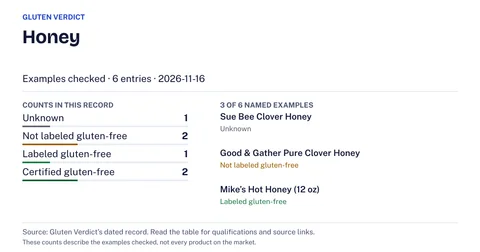 HoneyDepends on the productchecked Nov 16, 2026
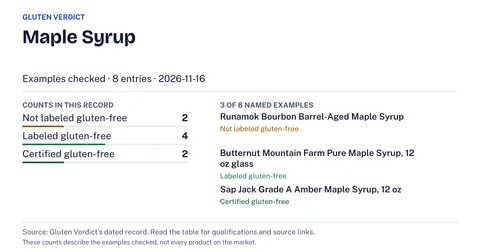 Maple SyrupNaturally gluten-freechecked Nov 16, 2026
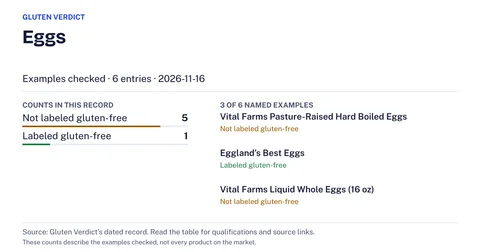 EggsNaturally gluten-freechecked Nov 16, 2026
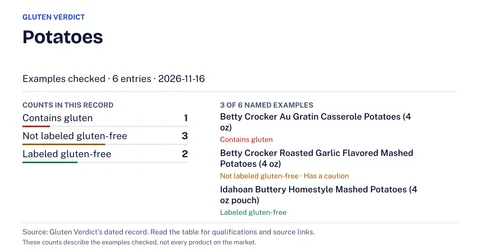 PotatoesNaturally gluten-free1 of 6 products we checked contains gluten: Betty Crocker Au Gratin Casserole Potatoes (4 oz)checked Nov 16, 2026
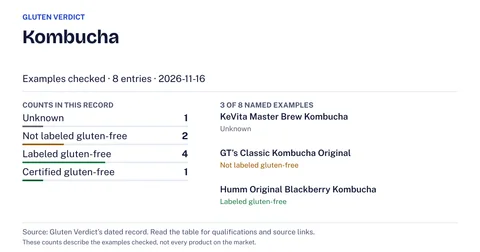 KombuchaDepends on the productchecked Nov 16, 2026
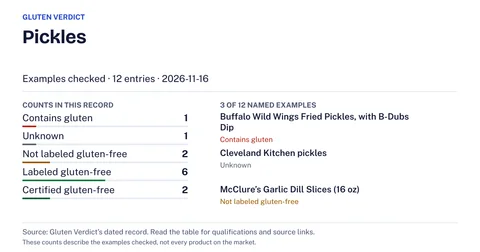 PicklesDepends on the product1 of 12 products we checked contains gluten: Buffalo Wild Wings Fried Pickles, with B-Dubs Dipchecked Nov 16, 2026
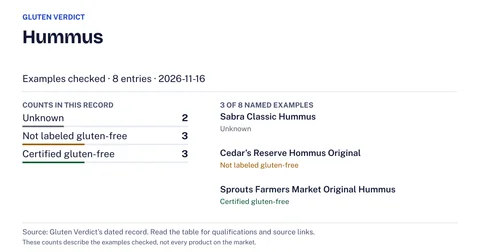 HummusDepends on the productchecked Nov 16, 2026
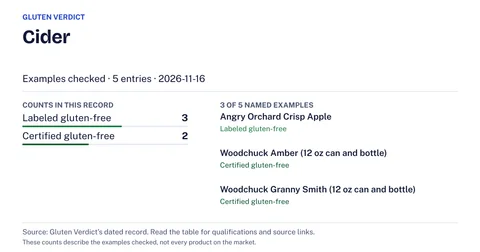 CiderNaturally gluten-freechecked Nov 16, 2026
 OatmealDepends on the productchecked Nov 16, 2026
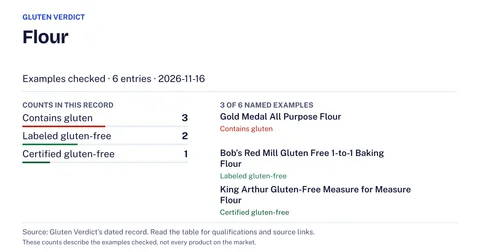 FlourContains glutenchecked Nov 16, 2026
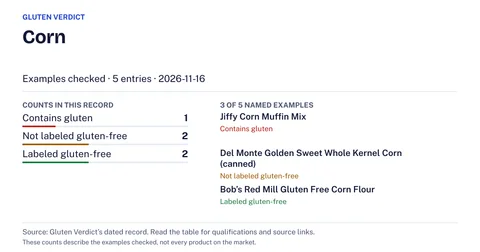 CornNaturally gluten-free1 of 5 products we checked contains gluten: Jiffy Corn Muffin Mixchecked Nov 16, 2026
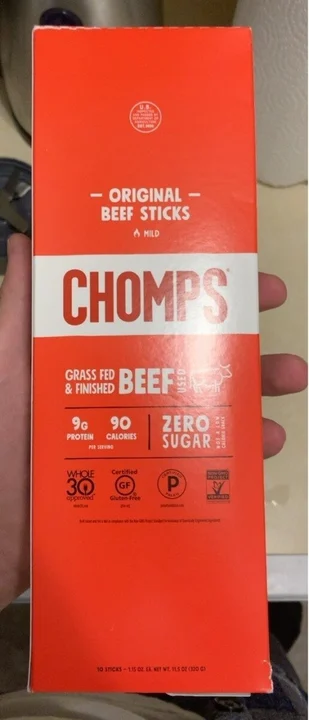 Beef jerkyDepends on the product3 of 8 products we checked contain gluten: Jack Link’s Original Beef Jerky, Jack Link’s Teriyaki Beef Jerky, and Old Trapper Teriyaki Beef Jerky (bulk)checked Nov 16, 2026
Questions people ask
Do farmers market vendors have to list allergens?
It depends on the state. Michigan and Washington require allergen labeling on cottage foods35, 40, Alabama requires a disclaimer that the food may contain allergens42, and Alaska’s 2024 law set exemptions from labeling43.
Is local honey gluten-free?
GIG says to check honey for added flavors and for processing in a shared facility with gluten-containing products24. Our verdict is at honey.
Does “naturally gluten-free” on a bag of grain mean it was tested?
Not necessarily. The National Celiac Association says a vendor may place a gluten-free claim on grain simply because it is “naturally” gluten-free46, and that you will need to investigate vendor by vendor47.
Do I need to wash produce from a farm?
GIG says produce is less likely to be exposed to gluten grains but should be rinsed anyway4.
More in Grocery shopping and meal planning
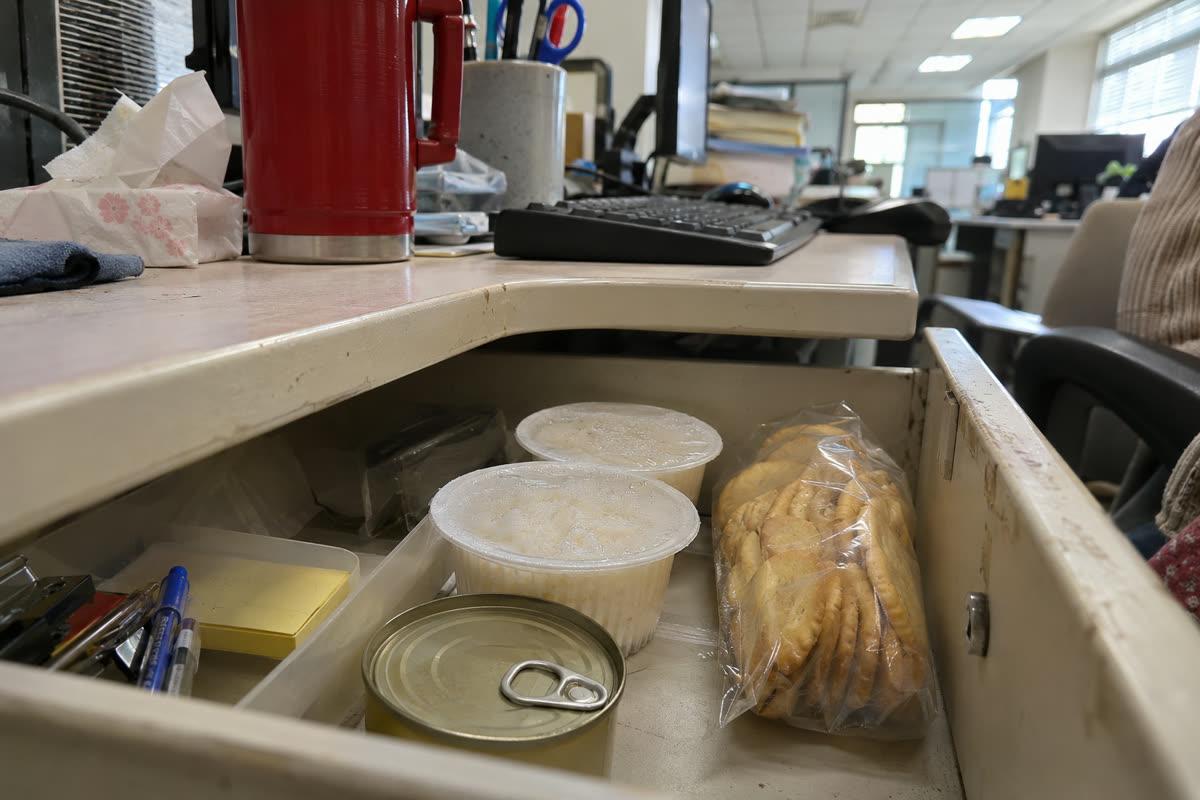 Packing a gluten-free work lunch from shelf-stable foodsWhat to pack for a gluten-free office lunch, which packaged items to label-check once, and how to use a shared fridge, microwave and toaster.
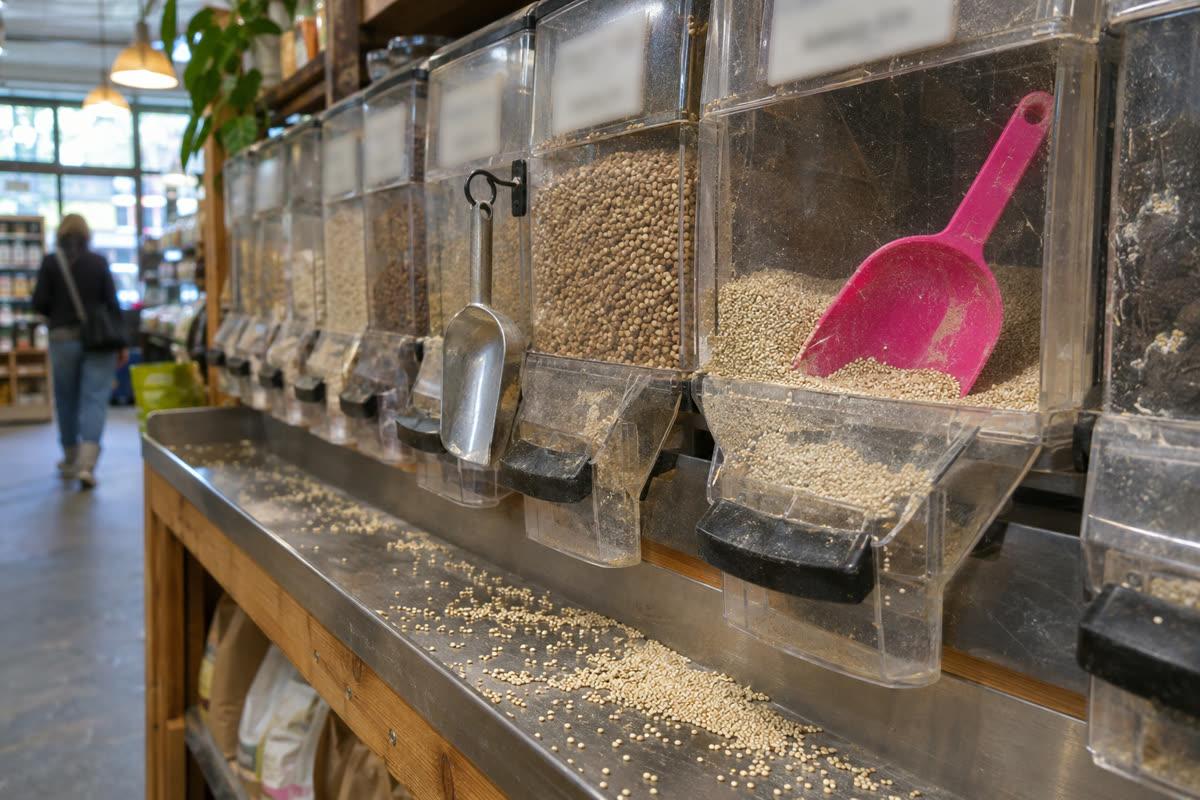 Deli, bakery and bulk-bin counters on a gluten-free dietFor each store counter (deli, bakery, bulk bins, bars): skip it, ask first, or buy the packaged item, and what a store’s own statement tells you.
 A starter gluten-free pantry: 30 shelf items and the label check for eachThirty shelf items for a first gluten-free pantry, tagged by the label check each needs, plus how to keep jars, toaster and colander apart at home.
 How to build a gluten-free emergency food supplyBuild a gluten-free emergency food supply: a stock list by food type, reading a freeze-dried pouch, maker shelf-life claims and what to bring to a shelter.
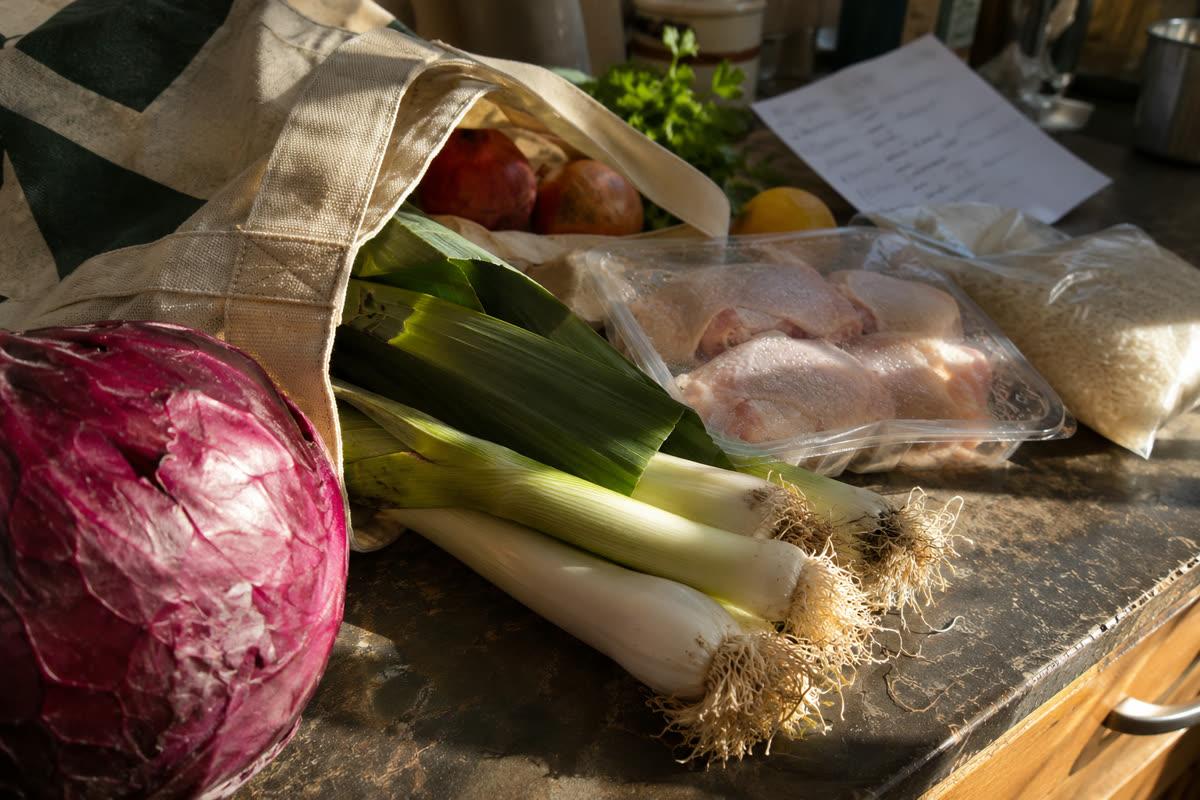 A gluten-free meal plan as a shopping template, by meal slotA weekly gluten-free shopping template: staples for each meal slot, the check each packaged item needs, and a ledger of when you last read each label.
 Store-brand gluten-free: what the tag, claim or seal rests onSort a store-brand item into certified, maker-stated or ingredient-only, see what each lets you conclude, and know what to ask the store.
Related guides
 A gluten-free grocery list by aisle for US supermarketsAn aisle-by-aisle gluten-free grocery list for US stores: what needs no label, what needs a check, and what stays off the list.
 What to ask a food maker about gluten, and how to read the replyHow to write to a food maker about gluten: what to include, questions that get a usable answer, and how to sort the reply.
 Gluten cross-contact at home: where it happens and what to do about itHow gluten reaches gluten-free food at home, whether to separate, wash or ask for each route, and which rules have lab data behind them.
 Gluten-free on a budget: what costs extra and what does notSort a gluten-free shopping list into plain foods, foods that need a statement and packaged substitutes, then compare costs and check each claim.
Sources
- [1, 10] US Food and Drug Administration, Gluten and Food Labeling, checked Nov 17, 2026.
- [2] National Institute of Diabetes and Digestive and Kidney Diseases (NIDDK), Eating, Diet, and Nutrition for Celiac Disease, checked Nov 17, 2026.
- [3, 4, 8, 12, 16, 19, 20, 21, 22, 25, 51, 53, 56, 58, 59] Gluten Intolerance Group, Gluten-Free Farm-to-Table, checked Nov 17, 2026.
- [5, 6, 17, 24] Gluten Intolerance Group, Farmers Markets: A Gluten-Free Win!, checked Nov 17, 2026.
- [7, 32, 33, 34, 43, 50] National Agricultural Law Center, Cottage Food Laws: Recent Trends and Major State Changes, checked Nov 17, 2026.
- [9] USDA Agricultural Marketing Service, Community Supported Agriculture: New Models for Changing Markets (April 2017), checked Nov 17, 2026.
- [11] US Food and Drug Administration, Food Allergies, checked Nov 17, 2026.
- [13, 46, 47, 62, 63] National Celiac Association, Gluten-Free Farm to Table webinar Q&A (April 2021), checked Nov 17, 2026.
Read on 2026-11-17: the list of questions for a vendor selling a single-ingredient grain or flour names: whether the vendor grows the grain on their own farm; whether wheat, barley or rye is grown adjacent to or in rotation with it; what steps prevent cross contact, including a dedicated gluten-free truck and a dedicated gluten-free milling and packaging area; whether the farm follows FDA’s gluten-free labeling rule; whether the product has been independently tested, and with the R5 ELISA test; and whether it is certified gluten-free.
- [14, 35, 36] Michigan Department of Agriculture and Rural Development, Cottage Food Labeling, checked Nov 17, 2026.
- [15, 37, 38, 48, 49] Texas Department of State Health Services, Texas Cottage Food Production, checked Nov 17, 2026.
Read on 2026-11-17: the list under “Food Labeling” that begins “The label must include:” names legible writing, the operation’s name, its address or unique identification number, the common or usual name of the product, any major food allergen used, a disclosure that the product was produced in a private residence not subject to governmental licensing or inspection, a batch number for pickled and fermented products, and (for time and temperature control foods) the date made and handling instructions. It does not name a full ingredient list.
- [18] US Food and Drug Administration, Food Allergen Labeling and Consumer Protection Act of 2004 (FALCPA), checked Nov 17, 2026.
- [23, 26, 27, 28, 29, 30, 31, 44, 55, 64, 67] Celiac Disease Foundation, Sources of Gluten, checked Nov 17, 2026.
Read on 2026-11-17: the list headed “Foods That May Contain Gluten” names, among other foods, self-basting poultry, pre-seasoned meats, salad dressings and marinades, and French fries (batter containing wheat flour or cross-contact from fryers).
Read on 2026-11-17: the list headed “Common Foods That Contain Gluten” names pastas (raviolis, dumplings, couscous, gnocchi), noodles, breads and pastries, crackers, baked goods (cakes, cookies, pie crusts, brownies), cereal and granola, and sauces and gravies.
Read on 2026-11-17: the list headed “Places where cross contact can occur” names toasters, colanders, cutting boards, flour sifters, fried foods cooked in oil shared with breaded products, shared containers including improperly washed containers, bulk bins at grocery stores or co-ops, and double-dipped condiments.
- [39, 40, 41, 52] Washington State Department of Agriculture, WSDA Cottage Food Labeling Guide, checked Nov 17, 2026.
- [42] Alabama Department of Public Health, Cottage Food, checked Nov 17, 2026.
- [45, 57, 65] US Food and Drug Administration, Questions and Answers on the Gluten-Free Food Labeling Final Rule, checked Nov 17, 2026.
- [54] Gluten Intolerance Group, 25 Ways Cross-Contact Could Happen (And How to Avoid It), checked Nov 17, 2026.
- [60, 61] Gluten Intolerance Group, How to Wash Beans & Grains (page for items not labeled gluten-free), checked Nov 17, 2026.
- [66] USDA Agricultural Marketing Service, Local Food Directories: Community Supported Agriculture (CSA) Directory, checked Nov 17, 2026.