Freezing gluten-free food: what holds up, how to thaw it and how to keep it apart
Short answer
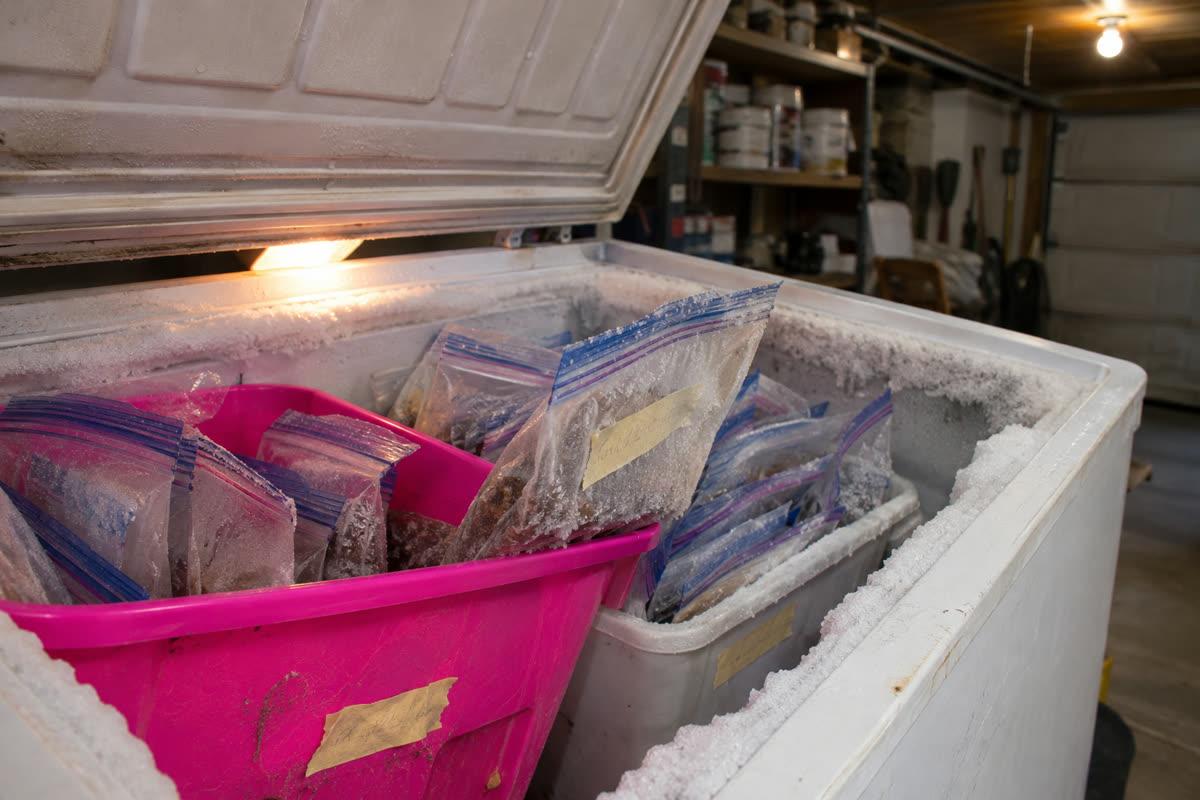
Start with the University of Georgia’s general freezing routine, then add the steps a shared freezer needs:
- Cool the food, pack it in single-meal portions and seal it in a tight container or bag1, 2, 3.
- Label each package with at least the product name, any added ingredients and the date4.
- Hold the freezer at 0°F or lower5.
- Thaw in the refrigerator, in cold running water under 70°F, or in the microwave if you will cook or serve the food at once; not at room temperature or in warm water6, 7.
- In a shared freezer, adapt GIG’s fridge and cupboard advice: keep gluten-free packages sealed, labeled and above gluten-containing food8, 9.
Part of Grocery shopping and meal planning, 15 guides
Key points
- The University of Georgia’s freezing guidance says freezing cannot improve the flavor or texture of any food10; freeze food while it is still at its best.
- The University of Georgia lists cooked pasta and rice frozen alone as mushy, while Gluten Intolerance Group (GIG) suggests freezing cooked gluten-free grains in meal-size packages; this guide sets them side by side11, 12.
- Two bread makers give freezer times from 3 months up to 12 months, so read your own loaf’s FAQ13, 14.
- In the two GIG cross-contact pages we read, the advice names the fridge, cupboard and pantry, not the freezer; applying it to the freezer is our adaptation15, 8.
- FDA says people with celiac disease should read and scrutinize labels16; reading a frozen package each time you buy it is our advice.
How to freeze: cool, portion, seal, label
The University of Georgia’s National Center for Home Food Preservation gives a short, general freezing routine. Cool foods before packaging, because that speeds freezing and helps keep color, flavor and texture1. Pack food in quantities that will be used for a single meal2. GIG says the same about portions, adding that they should match how much you will want to thaw at once17.
Choose packaging made for the freezer. The Georgia guidance lists rigid containers of plastic, glass or aluminum, foil pans, plastic bags and flexible wraps18. Rigid containers need a tight lid and a sealing edge free of food or moisture3. Liquids and wet foods need room to expand19. Breads are one of the foods the guidance says need no headspace20.
Label every package. The Georgia list includes the product name, any added ingredients and the packaging date, plus the number of servings and the form of the food4; GIG’s batch-cooking advice is to date it with either the cooking date or a use-by date21. On a gluten-free package, the label can also say so; see the shared-freezer section below.
Keep the freezer itself at 0°F or lower, and keep a thermometer in it5, 22. Do not load it with a lot of unfrozen food at once: the guidance says to add only what will freeze within 24 hours, usually 2 to 3 pounds per cubic foot of storage space23. Season lightly before freezing and add more when reheating24.
What holds up and what turns mushy
Two kinds of source speak here, and they do not always agree. The University of Georgia guidance lists foods that change in the freezer. GIG, a gluten-free charity, lists foods it suggests freezing. The table keeps each claim next to its publisher, so you can judge the difference.
| Food | What the source says | Who says it |
|---|---|---|
| Cooked rice and gluten-free grains (rice, quinoa, sorghum) | Freeze in bags or containers in meal-size packages12; cooked grains like rice or pasta last 1–2 months in the freezer25. | GIG |
| Cooked macaroni, spaghetti or rice, frozen alone | Listed as “Mushy, tastes warmed over” after thawing11. | University of Georgia |
| Baked or boiled potatoes | Listed as “Soft, crumbly, water-logged, mealy” after thawing26. | University of Georgia |
| Soups, stews and sauces | Leave room for expansion when freezing them19; GIG’s keeping time is in the table under “How long it keeps”27. | GIG |
| Milk sauces for casseroles or gravies | Listed as “May curdle or separate”28. | University of Georgia |
| Casseroles | 2–3 months in the freezer29; cheese or crumb toppings on casseroles are listed as “Soggy”30. | GIG; University of Georgia |
| Fried foods | Listed as fried foods, “All except French fried potatoes and onion rings”, which “Lose crispness, become soggy” after thawing32. | University of Georgia |
| Mayonnaise or salad dressing | Listed as “Separates”33. | University of Georgia |
| Gluten-free bread | Two makers’ FAQs give freezer times; see the bread section below13, 34. | Canyon Bakehouse; Little Northern Bakehouse |
The two sources point different ways on cooked pasta and rice (GIG gives a keeping time, Georgia lists a texture result), so treat this as a judgment call. GIG says cooked grains last 1–2 months in the freezer25, while the Georgia list calls the same foods mushy when frozen alone11. A practical reading is to freeze them mixed into a dish or in small portions and test one before committing a batch; that is our advice, not either publisher’s.
Neither source tells you whether a given food is gluten-free. That depends on the product: our verdicts for pasta, rice, mashed potatoes and soup show the sources we read for each.
How long it keeps
Freezer times vary by publisher and by what the food is. The Georgia guidance gives approximate months at 0°F, for foods prepared and packaged correctly, and says to use the shorter time for best quality35. Treat every figure here as that publisher’s, not a universal limit.
| Food | Time in the freezer | Who says it |
|---|---|---|
| Fruits and vegetables | 8–12 months36 | University of Georgia |
| Poultry | 6–9 months36 | University of Georgia |
| Ground meat | 3–4 months36 | University of Georgia |
| Cooked meats | 2–6 months31 | GIG |
| Cooked grains such as rice or pasta | 1–2 months25 | GIG |
| Soups, stews and sauces | About 6 months27 | GIG |
| Casseroles | 2–3 months29 | GIG |
| Canyon Bakehouse bread | Up to 3 months13 | Canyon Bakehouse |
| Little Northern Bakehouse bread | Up to 6 months in one FAQ answer34; up to 12 months in another14 | Little Northern Bakehouse |
Rotate by date. The Georgia guidance calls “first in, first out” a good policy, with older items used first37, and suggests posting an inventory by the freezer with dates38.
Gluten-free bread and rolls: what the makers say
Check the maker of the loaf you bought, because the numbers differ. Canyon Bakehouse recommends room temperature for 7-10 days or freezing for up to 3 months13, and says the refrigerator slows mold but makes the bread dry out and go stale quicker39. Little Northern Bakehouse says to keep its bread on the counter until the best-before date or in the freezer for up to 6 months34; elsewhere on the same FAQ it says up to 12 months14. We could not read either maker’s thawing instructions on the pages we fetched; Little Northern Bakehouse’s FAQ answers its defrosting question with an embedded video, which we did not watch.
For thawing, the Georgia guidance’s one line on bread is that precooked breads, cakes and cookies can be thawed at room temperature40, an exception to its rule against thawing at room temperature; it is general guidance for precooked breads, not a gluten-free maker’s instruction. If you toast frozen slices in a shared household, GIG puts toasters at the top of its list of appliances to designate gluten-free only, because their grooves and vents trap crumbs41, and suggests a toaster bag as a temporary solution if a separate appliance is not an option42; Coeliac UK likewise suggests toaster bags or a separate toaster for gluten-free bread43.
Whether a given loaf, bagel or tortilla is gluten-free is our verdict records’ job: see bread, bagels and tortillas.
Thawing and reheating
- Never thaw food at room temperature or in warm water7; the same page makes one exception, for precooked breads, cakes and cookies40.
- In the refrigerator at 40°F or less, which takes the longest and needs advance planning6, 44.
- In cold running water under 70°F, in a leak-proof package or plastic bag6, 45.
- In the microwave, if you will cook or serve the food immediately6.
Anything containing meat, fish, poultry, eggs or dairy should be thawed in the refrigerator or the microwave46. Most cooked or prepared foods need no thawing before heating, and the guidance says oven reheating helps keep texture47. Soups, stews and leftovers should reach at least 165°F in the center before serving48.
Reheating is a place where a shared kitchen matters. GIG’s advice for a shared oven is to wipe the racks and interior, use fresh foil on the rack, or set the dish on a clean baking sheet as a barrier49.
Keeping gluten-free packages apart in a shared freezer
GIG defines cross-contact as gluten crumbs or particles getting into gluten-free food in amounts that could cause an adverse reaction50. The charity’s published advice is written for the fridge, cupboard and pantry; none of the cross-contact pages we read names the freezer. What follows is how that advice carries over, and where it is ours.
- Seal every package. GIG says to keep gluten-free packages “securely packaged” when they share a fridge or cupboard with gluten-containing food8. Use the tight-lid and sealed-bag steps above3.
- Give them their own shelf or bin, above anything with gluten. GIG’s advice is to assign dedicated areas of the fridge and pantry15 and to put gluten-free packages above gluten-containing ones8. GIG also suggests higher shelves so crumbs cannot fall onto gluten-free products51. A lidded bin on the top shelf is our adaptation for a freezer.
- Label what is gluten-free. GIG suggests labeling food items and designating what is gluten-free9. Add “GF” to the product name and date the Georgia guidance asks for4.
- Use one color. GIG suggests assigning a color to gluten-free items, including storage containers52.
- Keep a list. The Georgia guidance says to post an inventory by the freezer and to organize by food groups38, 53; making “gluten-free” a group is our suggestion.
- Do not share serving tools. GIG says items such as colanders, sifters and waffle irons are harder to clean and should not be shared if possible54; in our reading, a scoop shared between a frozen gluten-free grain bag and a gluten-containing one falls under the same reasoning.
For the rest of the household routine, see cross-contamination, setting up a gluten-free kitchen and what the shared-kitchen evidence shows. For bread, Coeliac UK suggests separate bread boards for gluten-free and gluten-containing loaves55.
Frozen packaged foods: read the label again
In the US, a “gluten-free” claim on a food is voluntary, and a food that carries it must have any unavoidable gluten below 20 ppm56, 57. FDA also says people with celiac disease should read and scrutinize labels to avoid gluten ingredients16, and allows an advisory such as “made in a facility that also processes wheat” on a food that also carries the claim, if it is truthful and not misleading58.
Our advice, not FDA’s: read the package each time you buy, not just the first time, because the item in your freezer may come from a different batch than the one you checked. Our verdicts cover several freezer-aisle staples, including french fries, hash browns, pizza, pancakes and waffles; each shows the sources behind it and the date we read them. For label wording, see how to read food labels and may-contain labels.
What to leave out of the freezer
The Georgia list of foods that do not freeze well names cooked macaroni, spaghetti or rice frozen alone11, baked or boiled potatoes26, milk sauces28, cheese or crumb toppings on casseroles30, fried foods other than French fries and onion rings32, and mayonnaise or salad dressing33; the table above gives its after-thawing result for each.
Verdicts in this guide
 BreadContains glutenchecked Nov 16, 2026
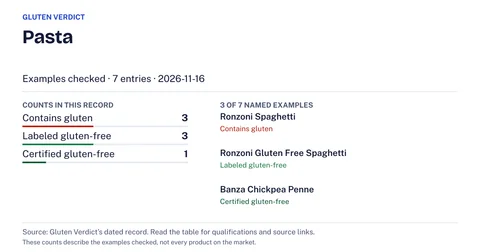 PastaContains glutenchecked Nov 16, 2026
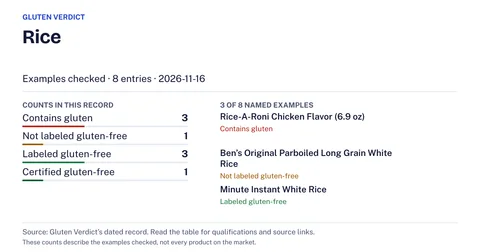 RiceNaturally gluten-free3 of 8 products we checked contain gluten: Rice-A-Roni Chicken Flavor (6.9 oz), Near East Original Rice Pilaf, and Ben’s Original Ready Rice Rice PilafBuy it labeled gluten-freechecked Nov 16, 2026
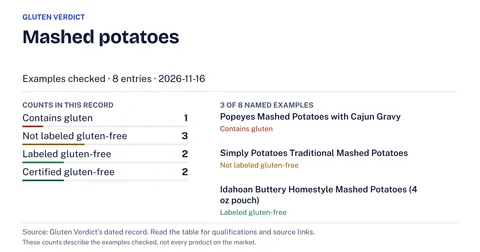 Mashed potatoesDepends on the product1 of 8 products we checked contains gluten: Popeyes Mashed Potatoes with Cajun Gravychecked Nov 16, 2026
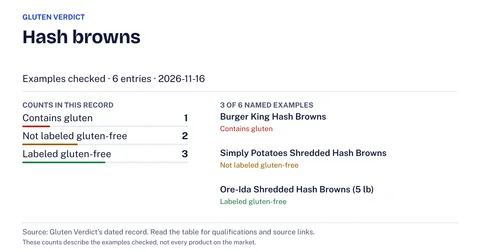 Hash brownsDepends on the product1 of 6 products we checked contains gluten: Burger King Hash Brownschecked Nov 16, 2026
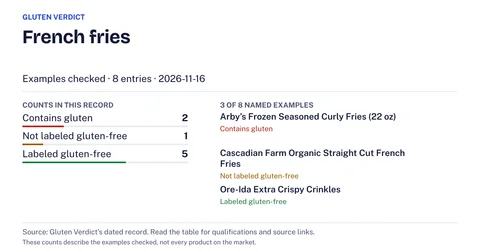 French friesDepends on the product2 of 8 products we checked contain gluten: Arby’s Frozen Seasoned Curly Fries (22 oz) and Checkers Frozen Crispy Seasoned Fries (28 oz)checked Nov 16, 2026
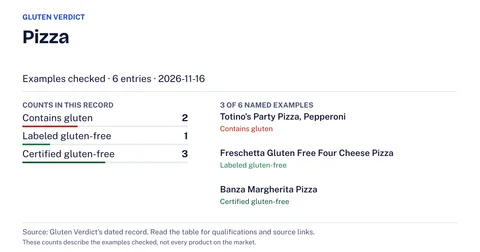 PizzaContains glutenchecked Nov 16, 2026
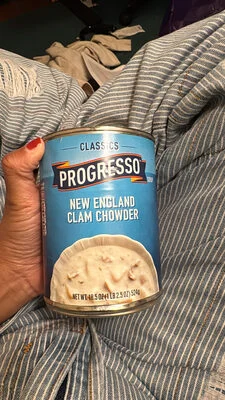 SoupDepends on the product3 of 8 products we checked contain gluten: Campbell’s Condensed Tomato Soup (10.75 oz), Campbell’s Condensed Cream of Mushroom Soup (10.5 oz), and Progresso Traditional Chicken Noodlechecked Nov 16, 2026
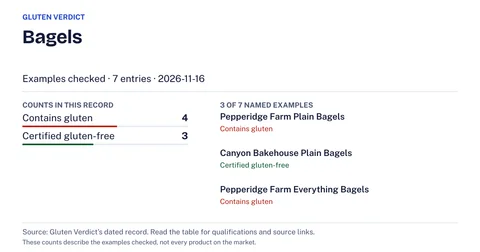 BagelsContains glutenchecked Nov 16, 2026
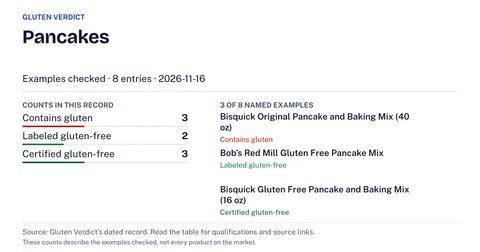 PancakesContains glutenchecked Nov 16, 2026
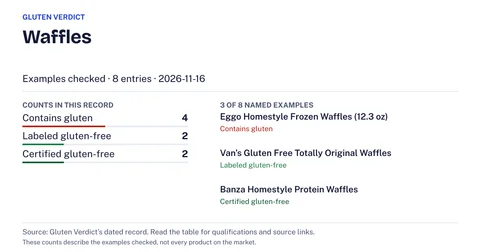 WafflesContains glutenchecked Nov 16, 2026
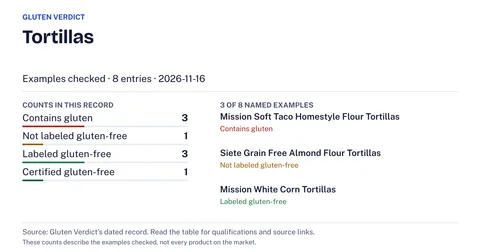 TortillasDepends on the product3 of 8 products we checked contain gluten: Mission Soft Taco Homestyle Flour Tortillas, Guerrero Riquisimas Soft Taco Flour Tortillas (24 ct), and Guerrero Corn and Wheat Tortillaschecked Nov 16, 2026
Questions people ask
Can you freeze gluten-free bread?
Two makers say yes. Canyon Bakehouse says up to 3 months13, and Little Northern Bakehouse says up to 6 months in one answer and up to 12 months in another34, 14. Check the maker of your loaf.
Does cooked gluten-free pasta freeze well?
The sources point different ways. GIG lists cooked grains such as rice or pasta at 1–2 months in the freezer25; the University of Georgia lists cooked macaroni, spaghetti or rice frozen alone as mushy after thawing11.
How do you thaw frozen food without leaving it on the counter?
The University of Georgia lists three methods: the refrigerator at 40°F or less, cold running water under 70°F, or the microwave when you will cook or serve the food at once6.
More in Grocery shopping and meal planning
 Frozen meals, pizza and nuggets on a gluten-free diet: what to read on the boxCheck a frozen meal, pizza or nugget box for gluten in order: the claim, any certification mark, the ingredient list, the Contains line and facility lines.
 Gluten-free bread, buns and wraps: what the package tells youHow to tell a gluten-free bread, bun or wrap from a wheat look-alike: certification mark, maker’s claim or ingredient list, in a fixed order.
 Deli, bakery and bulk-bin counters on a gluten-free dietFor each store counter (deli, bakery, bulk bins, bars): skip it, ask first, or buy the packaged item, and what a store’s own statement tells you.
 A gluten-free grocery list by aisle for US supermarketsAn aisle-by-aisle gluten-free grocery list for US stores: what needs no label, what needs a check, and what stays off the list.
 A gluten-free meal plan as a shopping template, by meal slotA weekly gluten-free shopping template: staples for each meal slot, the check each packaged item needs, and a ledger of when you last read each label.
 Gluten-free grocery pickup and delivery: setting substitutions and checking swapsHow to set no-substitution choices on Instacart, Target and Whole Foods orders, check each swapped item at the door, and report a swap that fails.
Related guides
 Storing gluten-free food in a shared fridge, pantry and freezerWhere gluten-free food goes in a shared fridge, pantry and freezer, how to label it so everyone follows, and what the sources say and leave out.
 Gluten-free meal prep in a shared kitchen: order, containers, labels and refrigerator timesHow to run a gluten-free prep session in a kitchen shared with wheat eaters: what to clean, what to handle first, how to label, and how long food keeps.
 Frozen fries, hash browns and vegetables: where wheat hides in the coating, seasoning and sauceHow to tell a plain frozen potato or vegetable bag from one with a wheat batter, coating, seasoning or sauce, using the ingredient list and Contains line.
 Does a gluten-free diet help you lose weight?What reviews, NIDDK and celiac charities report about a gluten-free diet and weight outside celiac disease, and what the substitute foods contain.
Sources
- [1, 2, 3, 4, 20] National Center for Home Food Preservation (University of Georgia), Packaging and Labeling Foods, checked Nov 17, 2026.
- [5, 23] National Center for Home Food Preservation (University of Georgia), Freezing Pointers, checked Nov 17, 2026.
- [6, 7, 40, 44, 45, 46, 47, 48] National Center for Home Food Preservation (University of Georgia), Thawing and Preparing Foods for Serving, checked Nov 17, 2026.
- [8, 9, 50, 54] Gluten Intolerance Group, 25 Ways Cross-Contact Could Happen (And How to Avoid It), checked Nov 17, 2026.
- [10, 18, 35, 36, 37] National Center for Home Food Preservation (University of Georgia), How Long Can I Store Frozen Foods, checked Nov 17, 2026.
Read on 2026-11-17: the table under “Approximate months of storage at 0°F” lists Fruits and Vegetables 8 - 12, Poultry 6 - 9, Fish 3 - 6, Ground Meat 3 - 4, and Cured or Processed Meat 1 - 2.
- [11, 24, 26, 28, 30, 32, 33] National Center for Home Food Preservation (University of Georgia), Foods That Do Not Freeze Well, checked Nov 17, 2026.
Read on 2026-11-17: the table headed “Foods That Do Not Freeze Well” lists “Cooked macaroni, spaghetti or rice”, usual use “When frozen alone for later use”, condition after thawing “Mushy, tastes warmed over”.
Read on 2026-11-17: the table headed “Foods That Do Not Freeze Well” lists “Irish potatoes, baked or boiled”, condition after thawing “Soft, crumbly, water-logged, mealy”.
Read on 2026-11-17: the table headed “Foods That Do Not Freeze Well” lists “Milk sauces”, usual use “For casseroles or gravies”, condition after thawing “May curdle or separate”.
Read on 2026-11-17: the table headed “Foods That Do Not Freeze Well” lists “Cheese or crumb toppings”, usual use “On casseroles”, condition after thawing “Soggy”.
Read on 2026-11-17: the table headed “Foods That Do Not Freeze Well” lists “Fried foods”, usual use “All except French fried potatoes and onion rings”, condition after thawing “Lose crispness, become soggy”.
Read on 2026-11-17: the table headed “Foods That Do Not Freeze Well” lists “Mayonnaise or salad dressing”, usual use “On sandwiches (not in salads)”, condition after thawing “Separates”.
- [12, 17, 19] Gluten Intolerance Group, Freeze Your Food! Plus other Tips & Tricks to Make Your Food Last, checked Nov 17, 2026.
- [13, 39] Canyon Bakehouse, FAQ’s (shelf life), checked Nov 17, 2026.
- [14, 34] Little Northern Bakehouse, Gluten-Free Baking & Product FAQs (shelf life), checked Nov 17, 2026.
- [15, 41, 42, 49, 51, 52] Gluten Intolerance Group, Your Kitchen, Their Kitchen, Our Kitchen: Navigating Gluten-Free Cohabitation, checked Nov 17, 2026.
- [16, 56, 57, 58] US Food and Drug Administration, Questions and Answers on the Gluten-Free Food Labeling Final Rule, checked Nov 17, 2026.
- [21, 25, 27, 29, 31] Gluten Intolerance Group, Batch Cook Your Way to an Easier Week, checked Nov 17, 2026.
- [22, 38, 53] National Center for Home Food Preservation (University of Georgia), Freezer Management, checked Nov 17, 2026.
- [43, 55] Coeliac UK, Cross contamination, checked Nov 17, 2026.