Gluten-free eating on a GLP-1 medication: what to read on shake, broth, bar and cup labels
Short answer
Read three things on each shake, broth, bar or cup, and leave calorie, protein and supplement targets to your doctor or dietitian33, 6:
- The “gluten-free” claim, which is voluntary and, on FDA-regulated foods, comes with a limit on unavoidable gluten: below 20 ppm8, 9.
- A certifier’s mark, which FDA allows and does not endorse; GFCO counts a product as certified if it is on its list and carries one of its marks12, 13, 18.
- Any shared-equipment line, which is voluntary and may appear beside a gluten-free claim11.
Part of Nutrition and combining diets, 24 guides
Key points
- NIDDK and the makers’ own pages describe these medicines as acting on appetite and food or calorie intake1, 2, 3, 4; small foods like shakes, broth and cups each have their own label to read.
- The Celiac Disease Foundation lists soup and energy bars among foods that may contain gluten23, 22, herbal or nutritional supplements among items to verify24, and malted milk or milkshakes among the malt forms that contain gluten21.
- On GFCO’s list, one brand’s cottage cheese appears as separate entries by size, fat percentage and flavor, so a single-serve cup needs its own check20.
Why this page looks at shakes, broths and cups
NIDDK describes semaglutide (Wegovy) and tirzepatide (Zepbound) as medicines that mimic hormones acting on areas of the brain that regulate appetite and food intake1, 2. Wegovy’s maker says the medicine helps reduce appetite “so you eat less”3, and Lilly says Zepbound reduces appetite and food intake4.
Lilly’s patient handout says you “may eat less” on these medicines and that it is important to eat foods that supply the nutrients you need5. This page does not say what to eat or how much. No source we read says these medicines call for shakes, broth, bars or cups; they are here because each is a small packaged food with its own label to read for gluten.
Three things to read on every package
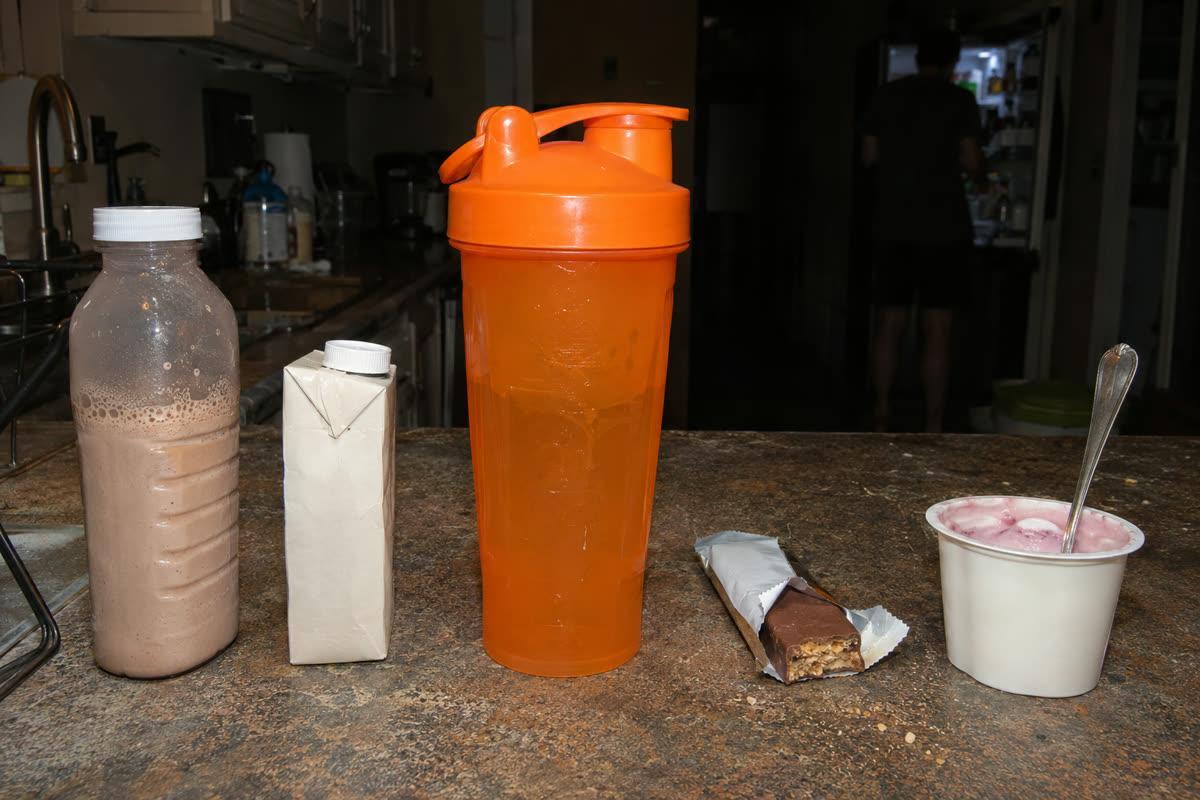
A shake, a carton of broth, a bar and a cottage cheese cup can each show a gluten-free claim, a certifier’s mark and a shared-equipment line. They are three separate statements with three different sources.
| On the package | What the rule or source says | What to remember |
|---|---|---|
| A “gluten-free” claim | FDA’s definition puts a limit on unavoidable gluten: below 20 ppm, which the rule words as below 20 mg of gluten per kg of food9. The claim is voluntary8. | A missing claim is not a warning by itself: FDA notes the claim is not required, so it may not appear even on a food that is gluten-free14. |
| A certifier’s mark | FDA lets makers print a certification program’s logo if its use is truthful and not misleading12, and does not endorse, accredit or recommend any particular program13. GFCO counts a product as certified if it is on GFCO’s list and carries one of its marks18. GFCO describes its standard as testing below the gluten-free threshold of the country of sale or 10 ppm, whichever is lower19. | Check the mark on the package against the certifier’s own list: how to check a seal in a certifier directory. |
| A shared-equipment or facility line | It is voluntary. FDA’s rule does not prohibit one beside a gluten-free claim if it is truthful and not misleading, and FDA judges such statements case by case11. | Read the claim, the line and the ingredient list together: may-contain wheat labels. |
The ingredient list is the fourth read. NIDDK’s advice for shopping is to carefully read food labels to check for grains that contain gluten30. Foods whose labels USDA regulates, which generally means meat, poultry and certain egg products, follow USDA’s rules instead of FDA’s gluten-free rule15; who regulates gluten-free claims explains the split.
Shakes and protein powders
FDA’s gluten-free rule applies to FDA-regulated packaged foods, including dietary supplements10, so a gluten-free claim on a protein powder sold as a supplement is held to the same definition as one on any other food.
On a flavored shake, the ingredient names matter. The Celiac Disease Foundation’s list of gluten sources includes malt in various forms, among them malted milk or milkshakes21. The same charity lists herbal or nutritional supplements and vitamins among the items to verify by reading the label or checking with the maker24, and says to read labels on pre-prepared smoothies27.
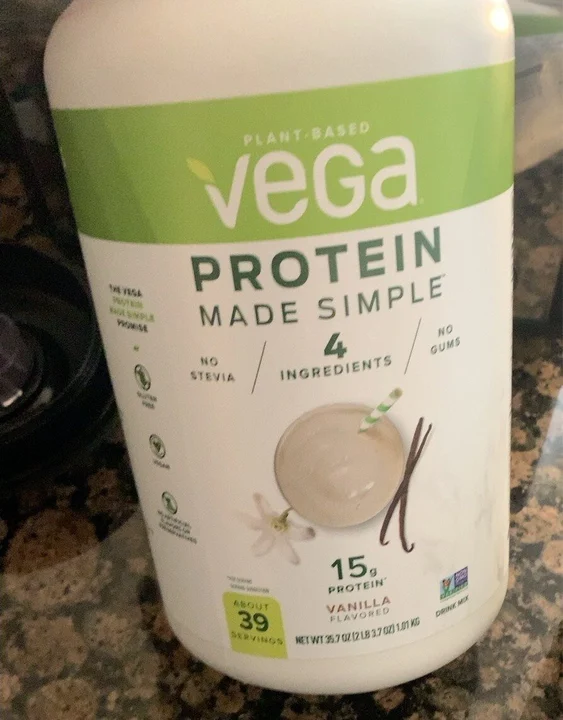
Two maker pages we read on 2026-11-17 show the signals appearing separately. Vega’s page for Vega Protein Made Simple describes the powder as supporting gluten-free dietary preferences35 and says it is manufactured in a facility that also processes milk, soy, peanuts, eggs, tree nuts and sesame36. Quest Nutrition’s page for its vanilla milkshake powder says it is processed in a facility that also processes wheat, among other foods37. FDA’s rule does not prohibit a line like Quest’s beside a gluten-free claim11, so a line naming wheat is a reason to read the rest of the package, not a verdict by itself.
For what we found product by product, see our verdicts for protein powder and smoothies, and the guide on protein shakes, energy drinks and kombucha.
Broths and soups
NIDDK lists soups among the foods where gluten may be found29. The Celiac Disease Foundation says many companies use wheat as a thickener in soups and sauces and advises reading the label of any pre-prepared or canned soup, especially cream-based ones26; its list of foods that may contain gluten adds that many soups contain barley23.
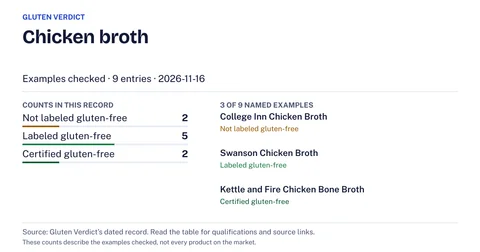
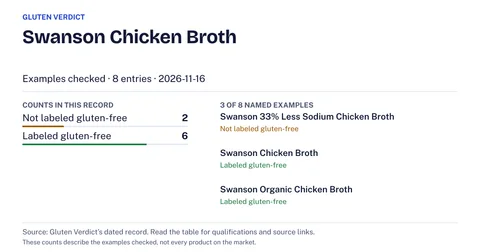
A broth is not a cream soup, but each carton still gets the same reads: claim, certifier mark, shared-equipment line and ingredient list. Swanson’s page on its gluten-free broths and stocks says its products undergo a rigorous testing process before being verified gluten free34. Our Swanson chicken broth verdict shows which chicken varieties carry the claim on their own pages. For other brands and for soup, see chicken broth, soup and the guide on canned soup thickeners and barley noodles.
Bars and small snacks
The Celiac Disease Foundation lists energy and granola bars among foods that may contain gluten: some bars may contain wheat as an ingredient, and most use oats that are not gluten-free22. Malt flavoring and malt extract are on the same charity’s list of gluten sources21.
Oats can carry a gluten-free claim. FDA says oats labeled gluten-free must contain less than 20 ppm gluten, and that a claim on oats does not require certification16. The Celiac Disease Foundation advises that, for people who can tolerate oats, the oats be specifically labeled gluten-free, including in granolas and granola bars28.
Our granola bar verdict shows what we read on bars from makers’ pages, and gluten-free snack bars: oats and barley malt goes through the names.
Cottage cheese and yogurt cups
The Celiac Disease Foundation lists dairy among naturally gluten-free food groups25. That describes dairy as a group; a flavored or mix-in cup is a separate label, and our yogurt verdict shows how much cups differ.
Makers and certifiers speak about cottage cheese in different ways. Daisy’s FAQ says all Daisy products are gluten free38. GFCO’s Product Finder, searched for “cottage” on 2026-11-17, listed Good Culture cottage cheese in several sizes, including 5.3 oz20; sizes, fat percentages and flavors appear as separate entries20, so the single-serve cup in your hand needs its own check. Our cottage cheese verdict has the maker pages we read.
Reading a label when the portion is small
FDA’s limit is written as a concentration in the food: 20 mg of gluten per kg of food9. Read the label the same way whether you eat a few spoonfuls or the whole container.
- Keep the package until the container is finished, so the claim and ingredient list stay on hand. On GFCO’s list, one brand’s cottage cheese appears as separate entries by size and flavor20.
- If you cannot tell from the package, NIDDK’s advice is to contact the company that makes the food or visit its website31.
- To check a photo of an ingredient list, use our gluten scanner.
Eating out: the steps NIDDK lists
For a restaurant, NIDDK’s steps are to tell the server you have celiac disease, ask about ingredients and how food is prepared, ask whether a gluten-free menu is available, and ask to talk with the chef for more detail32. FDA says restaurants’ use of gluten-free labeling should be consistent with the federal definition17. More in eating out with celiac disease.
What belongs to your doctor or dietitian
NIDDK says a doctor and a registered dietitian can help plan a healthy, balanced diet that supplies the nutrients you need33. Lilly’s handout says to talk to your doctor or other healthcare professional for help with healthy food choices6, and its Zepbound page, in a section on weight-loss plateaus, suggests reviewing your nutrition with a registered dietitian7.
This page gives no calorie, protein, fluid, vitamin or supplement targets, and it does not say whether to start, change or stop a medicine. Whether a medicine itself contains gluten is a separate check: see our guide on gluten in medications.
Verdicts in this guide
 Protein powderDepends on the productchecked Nov 16, 2026
 Chicken brothDepends on the productchecked Nov 16, 2026
 Swanson Chicken BrothLabeled gluten-freeCampbell’s (Swanson) · checked Nov 16, 2026
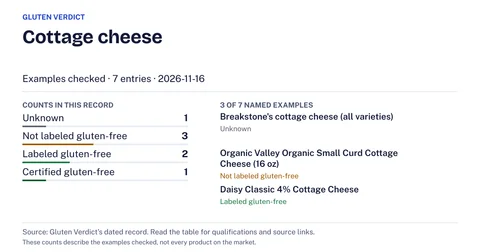 Cottage cheeseNaturally gluten-freechecked Nov 16, 2026
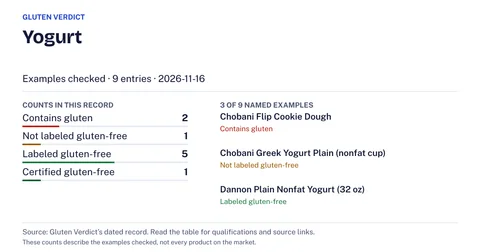 YogurtDepends on the product2 of 9 products we checked contain gluten: Chobani Flip Cookie Dough and Chobani Flip Cookies & Creamchecked Nov 16, 2026
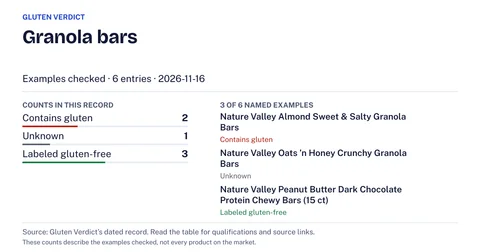 Granola barsDepends on the product2 of 6 products we checked contain gluten: Nature Valley Almond Sweet & Salty Granola Bars and Nature Valley Cinnamon Brown Sugar Soft-baked Oatmeal Squareschecked Nov 16, 2026
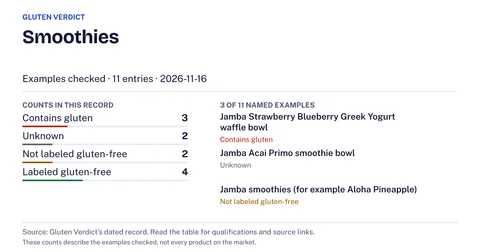 SmoothiesDepends on the product3 of 11 products we checked contain gluten: Jamba Strawberry Blueberry Greek Yogurt waffle bowl, Planet Smoothie Mountain Man Crunch, and Planet Smoothie Cookie Crusherchecked Nov 16, 2026
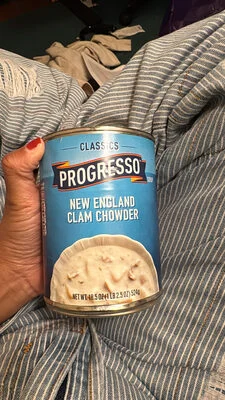 SoupDepends on the product3 of 8 products we checked contain gluten: Campbell’s Condensed Tomato Soup (10.75 oz), Campbell’s Condensed Cream of Mushroom Soup (10.5 oz), and Progresso Traditional Chicken Noodlechecked Nov 16, 2026
Questions people ask
Does a gluten-free claim mean a shake is certified?
No. The claim is FDA’s voluntary definition8, while certification is a separate program’s mark: FDA allows the logo of a certification program and endorses none12, 13.
Can a gluten-free product also say it is made in a facility that processes wheat?
FDA’s rule does not prohibit it, provided the statement is truthful and not misleading11.
Are plain cottage cheese and yogurt gluten-free?
The Celiac Disease Foundation lists dairy among naturally gluten-free food groups25. A flavored or mix-in cup is a separate label, so read it: see our yogurt and cottage cheese verdicts.
More in Nutrition and combining diets
 Gluten-free high-protein foods: where gluten hides in bars, powders, jerky and marinadesCheck each protein product type for its gluten trap: seitan, jerky, bars, powders, sausage and broth, with what makers say on their own pages.
 Gluten-free for older adults: swallowing difficulty, small appetite and thickenersHow to check thickeners, nutrition drinks and soft foods for a gluten statement, what the IDDSI texture levels are, and whom to ask about swallowing.
 What to eat after a celiac diagnosis: what the sources document and what they do notBone broth, collagen, glutamine or plain staples? What NIDDK, ACG and celiac charities document after a diagnosis, and what no page we read names.
 Gluten-free and dairy-free: how to check a US label for bothUS labels treat milk and gluten under different rules. How to read for both, which makers state both claims, and what to ask when eating out.
 Gluten-free fuel for training and race day: gels, bars, protein powder and aid stationsHow to check gels, chews, bars, protein powder and drinks for gluten, read sport-certification marks, and plan aid-station and pre-race food.
 Gluten-free vegetarian protein: what to check on beans, lentils, tofu and tempehWhat to read on beans, lentils, tofu, tempeh and meat substitutes when you are vegetarian and gluten-free: stray grain, added grains, sauces and batters.
Related guides
 Weight gain or loss after a celiac diagnosis: what the research foundWhat two studies found about weight before and after a celiac diagnosis, what sources say about gluten-free foods, and what to bring to a dietitian.
 Gluten in medications: what the label, DailyMed and a pharmacist can showFDA’s gluten-free food rule does not cover drugs. Use the ingredient list, DailyMed, the maker and a pharmacist, and know what each can show.
 Gluten-free breakfast: what to check on the label and in your kitchenGo through a usual breakfast item by item: what is gluten-free by nature, what needs a label check, and which kitchen habits cause trouble.
 Canned soup and gluten: roux, barley, noodles and which cans carry a claimRead a can of soup for the three ways gluten gets in (wheat thickener, barley or malt, noodles) and see which makers state a gluten-free claim.
Sources
- [1, 2] NIDDK, Prescription Medications to Treat Overweight & Obesity, checked Nov 17, 2026.
- [3] Novo Nordisk (wegovy.com), Getting Started on Wegovy for Weight Loss, checked Nov 17, 2026.
- [4] Eli Lilly (zepbound.lilly.com), Zepbound FAQs, checked Nov 17, 2026.
- [5, 6] Eli Lilly (medical.lilly.com), Healthy eating while on obesity management medications, checked Nov 17, 2026.
- [7] Eli Lilly (zepbound.lilly.com), Life on Zepbound and what to expect, checked Nov 17, 2026.
- [8, 10, 11, 12, 15, 16] US Food and Drug Administration, Questions and Answers on the Gluten-Free Food Labeling Final Rule, checked Nov 17, 2026.
- [9] Electronic Code of Federal Regulations, 21 CFR 101.91 Gluten-free labeling of food, checked Nov 17, 2026.
- [13, 14, 17] US Food and Drug Administration, Gluten and Food Labeling, checked Nov 17, 2026.
- [18] Gluten-Free Certification Organization, GFCO Product Finder, checked Nov 17, 2026.
- [19] Gluten-Free Certification Organization, GFCO: about the certification, checked Nov 17, 2026.
- [20] Gluten-Free Certification Organization, GFCO Product Finder search: cottage, checked Nov 17, 2026.
Read the GFCO Product Finder search for “cottage” on 2026-11-17 (first results page): the entries shown are brand Good Culture, including “2% Cottage Cheese, 16 oz”, “2% Cottage Cheese, 48 oz”, “2% Cottage Cheese, 5.3 oz”, “4% Cottage Cheese, 5.3 oz”, “3G 2% Peach Cottage Cheese” and “3G 2% Blueberry Cottage Cheese”, and the entries that show a category list Dairy Products with sales region US.
- [21, 22, 23, 24] Celiac Disease Foundation, Sources of Gluten, checked Nov 17, 2026.
Read on 2026-11-17: under the heading “Other Items That Must Be Verified By Reading The Label Or Checking With The Manufacturer”, the list names lipstick, lip gloss and lip balm and other cosmetics used near the mouth; oral care and dental products; communion wafers; herbal or nutritional supplements; drugs and over-the-counter medications; vitamins and supplements; and play-dough.
- [25, 26, 27, 28] Celiac Disease Foundation, Gluten-Free Foods, checked Nov 17, 2026.
Read on 2026-11-17: the sentence “The most cost-effective and healthy way to follow the gluten-free diet is to seek out these naturally gluten-free food groups, which include:” is followed by a list naming fruits, vegetables, meat and poultry, fish and seafood, dairy, and beans, legumes, and nuts.
- [29, 30, 31, 32, 33] NIDDK, Celiac Disease: Eating, Diet, & Nutrition, checked Nov 17, 2026.
- [34] Campbell’s (Swanson), Gluten Free Broths & Stocks, checked Nov 17, 2026.
- [35, 36] Vega, Vega Protein Made Simple, checked Nov 17, 2026.
- [37] Quest Nutrition, Vanilla Milkshake Protein Powder, checked Nov 17, 2026.
- [38] Daisy Brand, Daisy FAQs, checked Nov 17, 2026.